
Singularity · Artificial intelligence
What artificial intelligence changes on the way to the infrastructure singularity
Artificial intelligence designs, structures and runs PPP projects, and it is one of three technologies bringing the infrastructure singularity closer. Every organization guide sets out what it changes for one kind of organization.
The singularity
How artificial intelligence brings the singularity closer
The infrastructure singularity is the point where the built world starts improving itself faster than anyone can direct it. Artificial intelligence is the part of that future that makes decisions. It reads the data coming from a road, a power line or a water network, works out what should happen next and learns from the result.
It also makes each new project cheaper to prepare, because it can draft the studies and compare the bids. That moves Jordan toward the PPP singularity, the point at which it becomes cheaper to build the pilot than to conduct the study.
Read about the infrastructure singularityIn every organization guide
A section of its own in every organization guide
Page 22
Artificial intelligence
How AI designs, structures and runs PPP projects.
Each of the 96 guides writes this section for its own kind of organization; 94 of them are gathered below.
Read the organization guide for AI Companies in JordanDownload the guide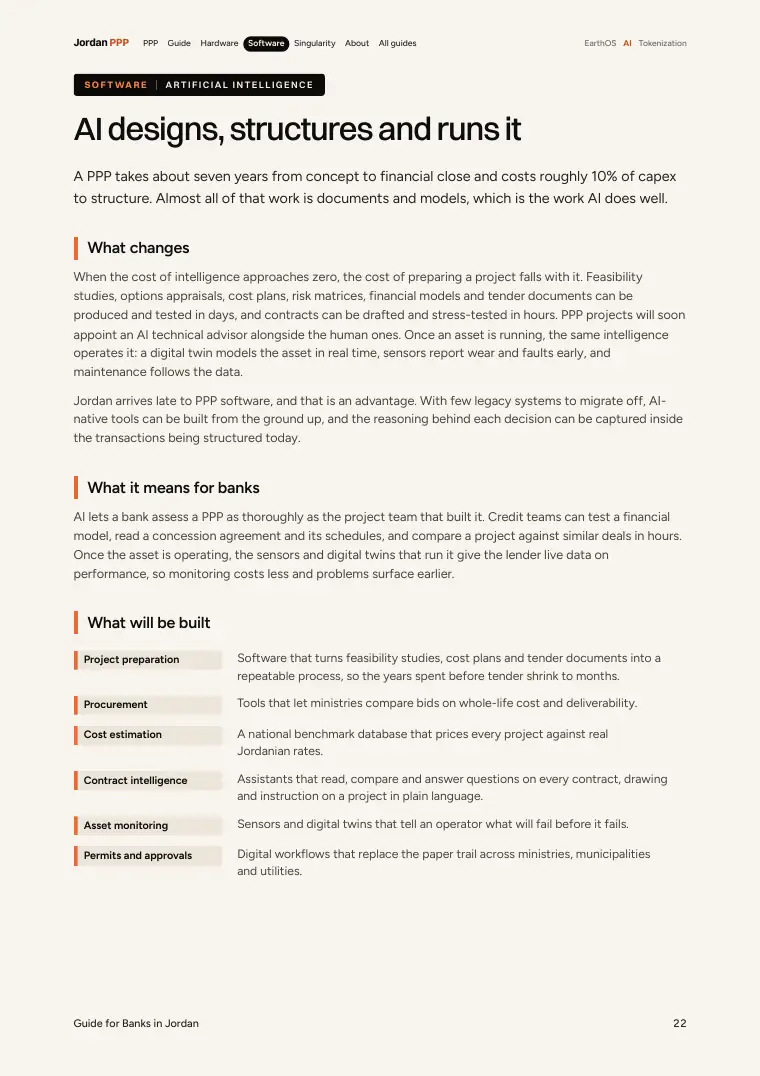
Page 22 of the guide for banks
In the organization guides’ own words
“AI gives a ministry the capacity of a much larger PPP team.”
“AI lets a bank assess a PPP as thoroughly as the project team that built it.”
“AI lets an energy developer site, size and run its projects on data.”
The engine
How AI becomes the engine behind $500 trillion of tokenized PPP infrastructure
PPP projects first become machine-readable systems. Contracts become logic, risk becomes data, assets become models and performance becomes measurable in real time. Decisions become predictive, planning continuous and governance dynamic.
- 01
AI turns infrastructure into data
AI makes roads, pipes and power plants machine-readable, the first condition for tokenizing them.
- 02
AI standardizes complexity
Tokenization needs standards, and AI creates them at scale.
- 03
AI models risk automatically
AI makes the risk of each asset visible, comparable and priced, so investors can value it.
- 04
AI automates financial structuring
Millions of assets are too many to structure by hand.
- 05
AI enables real-time transparency
Tokenized assets need continuous trust, and AI becomes the watchtower.
- 06
AI makes compliance scalable
Systems worth $500 trillion depend on automated compliance.
- 07
AI creates digital twins
Tokens will represent living systems, continuously modeled.
- 08
AI enables global scale
$500 trillion requires planetary coordination.
- 09
AI creates liquidity intelligence
AI matches buyers and sellers and prices each asset as it trades.
- 10
AI becomes the operating layer
Tokenization sets the structure of ownership, and AI runs the assets inside it.
From the 96 organization guides
What AI changes for each kind of organization
Point at an organization to read what its guide says.Tap an organization to read what its organization guide says.
A national initiative can treat AI as shared public capacity. Open tools for preparing feasibility studies, comparing bids and reading contracts can serve every ministry at once, and young Jordanian engineers can build them on local data and local rates. The same tools let the public follow each project from preparation to operation in plain language.
Read the organization guideDownload the guideAI-assisted preparation lets every ministry draw on the same tools and the same data. A shared platform can draft feasibility studies, output specifications and tender documents, test value for money, compare bids on whole-life cost and keep every contract and pilot result in one record that each ministry can search. A small central team can maintain it for all 40 contracting authorities.
Read the organization guideDownload the guideAI can give every member a clear view of the pipeline. It can read feasibility studies, contracts and budget lines, flag the long-term payments and risks they create and answer a member’s questions in plain Arabic or English. A parliamentary research team can use the same tools to compare Jordan’s PPP laws with those of other countries.
Read the organization guideDownload the guide
AI gives a ministry the capacity of a much larger PPP team. Its staff can draft output specifications, test value for money, compare bids on whole-life cost and read every contract on a project in plain language. Once an asset is running, sensors and digital twins show how it performs every day, so the ministry supervises on evidence and pays on results.
Read the organization guideDownload the guideAI gives a state-owned company the capacity of a much larger PPP team. Its staff can draft output specifications, test value for money and compare bids on whole-life cost. On the network, models forecast demand, balance pressure and load, flag leaks and faults from meter and sensor readings and schedule pumping when power costs least, so the company supervises its partners on evidence and pays them on results.
Read the organization guideDownload the guideAI gives a regulator or market institution the capacity to review and supervise more complex instruments with the same staff. Prospectuses, concession agreements and financial models can be read and compared in hours, disclosures can be checked against live performance data from the asset, and unusual trading or settlement patterns can surface early. Any supervisory use of AI would follow the institution’s own standards on data, privacy and accountability.
Read the organization guideDownload the guideAI can plan the upkeep of a large estate. It can track the condition of every building, vehicle and generator, forecast energy and water use at each base and schedule repairs before equipment fails. An institution can use those tools to hold its PPP partners to their performance standards and spend each budget where it matters most.
Read the organization guideDownload the guideAI can help courts and centers run their facilities and services. It can index case files, plan hearing rooms and schedules, track the condition of every building and forecast energy and water use at each site. An institution can use those tools to hold its PPP partners to their performance standards and spend each budget where it matters most.
Read the organization guideDownload the guideAI lets a regional authority plan and run its territory as one system. A digital twin of the region joins land use, utilities, visitor flows and traffic, so each PPP is sized to forecast demand and priced on evidence. A small PPP unit can also draft output specifications, compare bids on whole-life cost and read every contract in its region in plain language.
Read the organization guideDownload the guideAI lets a small municipal team prepare and supervise projects that once needed outside advisors. It can draft the feasibility report for a car park, compare bids on whole-life cost and read every contract in plain language. Once a service is running, sensors and AI show which car parks are full, which street lights have failed and when each bin needs collecting.
Read the organization guideDownload the guideAI fits Amman’s busiest systems first. It can plan bus routes and traffic signals, forecast water and power demand, find leaks in old networks and route waste collection across the city’s districts. An organization in Amman can bring those tools into every concession it joins and use the same data to find the next project worth proposing.
Read the organization guideDownload the guideAI fits Zarqa’s industrial systems first. It can plan factory energy use, forecast demand for fuel and water, run treatment plants with fewer losses, schedule trucks through the industrial areas and plan bus services between Zarqa and Amman. An organization in Zarqa can bring those tools into every concession it joins and use the same data to find the next project worth proposing.
Read the organization guideDownload the guideAI fits Irbid’s most pressing systems first. It can schedule irrigation across the northern Jordan Valley, forecast water and power demand, plan bus routes for a city of students and track crops from farm to market. An organization in Irbid can bring those tools into every concession it joins and use the same data to find the next project worth proposing.
Read the organization guideDownload the guideAI fits Balqa’s busiest systems first. It can schedule irrigation across the central Jordan Valley, forecast water and power demand for the Dead Sea hotels, guide visitors through Salt’s historic city and track crops from farm to market. An organization in Balqa can bring those tools into every concession it joins and use the same data to find the next project worth proposing.
Read the organization guideDownload the guideAI fits Madaba’s visitor and water systems first. It can forecast visitor flows at the Church of the Map and Mount Nebo, plan traffic on the Kings’ Highway, find leaks in the city’s water network and schedule irrigation for the olive and fruit farms. An organization in Madaba can bring those tools into every concession it joins and use the same data to find the next project worth proposing.
Read the organization guideDownload the guideAI fits Mafraq’s largest systems first. It can forecast solar output and balance it with storage, find losses in long water pipelines, plan truck flows on the routes to Iraq and Syria and run services for Zaatari refugee camp. An organization in Mafraq can bring those tools into every concession it joins and use the same data to find the next project worth proposing.
Read the organization guideDownload the guideAI fits Jerash’s visitor and farm systems first. It can forecast visitor flows at the Roman city and the festival, plan traffic between Amman and Irbid, manage water for the olive groves and watch the Dibbeen forest for fire. An organization in Jerash can bring those tools into every concession it joins and use the same data to find the next project worth proposing.
Read the organization guideDownload the guideAI fits Ajloun’s forests and farms first. It can spot fire risk and tree disease from drone images, forecast olive and fruit harvests and plan visitor flows to the castle, the reserve and the cable car. An organization in Ajloun can bring those tools into every concession it joins and use the same data to find the next project worth proposing.
Read the organization guideDownload the guideAI fits Karak’s heaviest systems first. It can plan mineral and cement haulage, forecast truck flows on the Desert Highway and the King’s Highway, balance water and power demand for industry and farms and guide visitors at the castle. An organization in Karak can bring those tools into every concession it joins and use the same data to find the next project worth proposing.
Read the organization guideDownload the guideAI fits Tafileh’s energy and mines first. It can forecast wind output, plan maintenance on turbines and mining equipment, track dust and water use around the mines and plan visitor flows to the Dana reserve. An organization in Tafileh can bring those tools into every concession it joins and use the same data to find the next project worth proposing.
Read the organization guideDownload the guideAI fits Ma’an’s largest systems first. It can forecast solar output and match it to demand, plan phosphate haulage and truck flows on the Desert Highway, manage scarce water and guide visitor flows at Petra and Wadi Musa. An organization in Ma’an can bring those tools into every concession it joins and use the same data to find the next project worth proposing.
Read the organization guideDownload the guideAI fits Aqaba’s busiest systems first. It can plan berths and yard moves, forecast truck and cargo flows, balance water and power demand across the zone and price hotel and tourism services in real time. An organization in Aqaba can bring those tools into every concession it joins and use the same data to find the next project worth proposing.
Read the organization guideDownload the guideAI lets an embassy see the whole pipeline at once. It can read tender notices, feasibility studies and ministry plans as they appear, match each project to the companies at home that can deliver it and draft the briefings that send the right firm to the right meeting. A development agency can fund AI tools that help Jordan’s contracting authorities prepare projects faster.
Read the organization guideDownload the guide
03Capital
AI lets a bank assess a PPP as thoroughly as the project team that built it. Credit teams can test a financial model, read a concession agreement and its schedules, and compare a project against similar deals in hours. Once the asset is operating, the sensors and digital twins that run it give the lender live data on performance, so monitoring costs less and problems surface earlier.
Read the organization guideDownload the guideAI lets a firm research a PPP security as closely as the team that built the asset. Analysts can read a concession agreement, test a financial model and track traffic, tariffs and availability in real time, and pricing models can quote fair values for thinly traded issues every day. A firm that builds these tools can cover more issues with the same team.
Read the organization guideDownload the guideAI lets a development finance institution prepare and appraise more projects with the same team. Feasibility studies, environmental and social reviews, financial models and contracts can be drafted, tested and compared in days, so preparation funding goes further and appraisal moves faster. Once a project is running, sensors and digital twins report its performance and its development results on live data, which makes monitoring cheaper and results easier to prove.
Read the organization guideDownload the guideAI lets a fund assess a PPP as thoroughly as the team that prepared it. Deal teams can test a financial model, read a concession agreement and compare a bid against similar deals in hours, which lowers the cost of every bid. Once the asset is operating, digital twins and sensors give the asset manager live performance data, so the fund can lift availability, cut operating costs and value each holding on evidence.
Read the organization guideDownload the guideAI changes the value of the companies a private equity firm owns. Operators that run assets with AI need fewer people per asset and predict failures before they cost money, which raises margins across a portfolio of concessions. The firm can also screen the whole pipeline, model each project and run due diligence in days.
Read the organization guideDownload the guideAI gives a long-term owner a clear view of what it holds. Investment teams can read a concession agreement, test a financial model and compare an asset against similar deals in hours, which makes direct investment possible with a lean team. Once the asset is operating, digital twins and sensors report its condition in real time, so the fund can value each holding on evidence and plan the maintenance that protects value until handback.
Read the organization guideDownload the guideAI lets an insurer underwrite a PPP as thoroughly as the team that built it. Underwriters can read a concession agreement and its risk matrix, test the construction program and compare a project against similar risks in hours. Once the asset is operating, digital twins and sensors give the insurer live data on its condition, so losses can be prevented and cover priced on how the asset actually performs.
Read the organization guideDownload the guideAI lets a small investment team review a PPP as thoroughly as a large fund. A family office can test a financial model, read a concession agreement and its schedules, and compare a deal against similar projects in hours, which makes direct and club investing possible without a large staff. Once the asset is operating, digital twins and sensors give the family live data on how its holding performs.
Read the organization guideDownload the guideAI lets investors far from Amman follow a PPP as closely as a local team. A diaspora fund can test a financial model, read a concession agreement and its schedules, and compare a deal against similar projects in hours, which makes careful investing possible without a large staff in Jordan. Once the asset is operating, digital twins and sensors report its performance to every investor, wherever they live.
Read the organization guideDownload the guideAI can judge the credit of a small firm from its signed contracts, invoices and payment history. It can score borrowers in minutes, forecast cash flows on each subcontract, watch how each project pays its suppliers and spot repayment trouble early. A microfinance institution can use those tools to lend faster and to more of the small businesses inside every PPP.
Read the organization guideDownload the guideAI lets a credit guarantee institution judge more borrowers with the same team. It can read a young company’s contracts, payments and project data, score the risk of each loan and watch the asset that repays it in real time. A credit guarantee institution can share those scores with its partner banks and price each guarantee on live data from the projects it backs.
Read the organization guideDownload the guide
AI cuts the cost and time a developer carries before financial close. A small team can screen the pipeline, read a tender and its draft concession agreement, build and stress-test a financial model and draft a direct proposal in days, so the company can bid on more projects with less development capital at risk. After close, the same models feed the digital twin that the lenders, the operator and the government rely on.
Read the organization guideDownload the guideAI lets a zone plan and run its land, utilities and services as one system. A digital twin forecasts power, water and traffic demand as tenants arrive, so each utility PPP is sized and priced correctly, and the same model schedules maintenance and flags faults once the assets run. A small zone team can also draft output specifications, compare bids on whole-life cost and answer tenant questions in hours.
Read the organization guideDownload the guideAI lets a contractor price, plan and bid like a developer. A small team can read a tender and its contract, build a cost plan and a construction schedule, and test a financial model in days, so your company can bid on more projects for less. The same tools track progress on site and, once the asset is running, feed the digital twin that guides its maintenance.
Read the organization guideDownload the guideAI lets a developer plan a district the way an operator will run it. Master plans, massing studies, cost plans and financial models can be tested across many options in days, and permits and approvals can move through digital workflows. Once the district is built, a digital twin runs its energy, water, parking and maintenance and shows the government partner how the public assets perform.
Read the organization guideDownload the guideAI lets a housing developer design for cost and for the families who will live in each home. Layouts, massing, cost plans and financial models can be tested across many options in days, and applications, eligibility checks and approvals can move through digital workflows. Once residents move in, a digital twin tracks energy, water, rents and maintenance and shows the government partner how each home performs.
Read the organization guideDownload the guideAI changes the economics of engineering advice. A small team can now draft a feasibility study, test design options, price them and check a contractor’s cost plan in days, and an AI technical advisor can sit beside the human one on every review. Firms that build these tools into their practice will prepare more projects with the same people and offer governments faster preparation at lower cost.
Read the organization guideDownload the guide
05Advisors and professional bodies
AI changes how a PPP practice works. A concession agreement and its schedules can be read, compared against similar deals and checked for gaps in hours, and obligations can be tracked automatically for the life of the contract. A firm that builds these tools into its practice can advise on more projects with a smaller team and offer clients fixed prices for standard work.
Read the organization guideDownload the guideAI changes the economics of financial advice. A model that took weeks to build can be drafted, checked and stress-tested in days, every scenario in a value-for-money or fiscal assessment can be run at once, and a model audit can trace every formula and test every input automatically. A firm that builds these tools into its practice can serve more governments and bidders with the same team and spend its time on judgment and negotiation.
Read the organization guideDownload the guideAI lowers the cost of a bid to a level that smaller member firms can afford. A small firm can read a tender, draft its technical offer, price its scope against real rates and check a contract in days, work that once needed a large bid team. A member body can offer these tools to all its members at once and teach them to use the tools well.
Read the organization guideDownload the guide
AI moves an operator from repairing failures to preventing them. Sensors and digital twins model each asset in real time, forecast demand and flag the pump, transformer or crane that will fail before it does, so maintenance follows the data. In a performance-based PPP every avoided outage protects revenue, and the same models let your company price a bid on the true condition of the asset.
Read the organization guideDownload the guideAI moves facility management from scheduled rounds to service on demand. Sensors and building management systems report temperature, air quality, occupancy and equipment condition in real time, and AI flags the chiller, lift or pump that will fail before it triggers a deduction. The same models route each fault to the right technician and let your company price a bid on the true lifecycle cost of each building.
Read the organization guideDownload the guideAI runs on data and compute, and a telecom operator supplies both. Every digital twin and predictive model on a PPP asset depends on a network that delivers sensor data without gaps and a data center that processes it inside Jordan. An operator can sell that capacity under contracts as long as the concession and use the same AI to keep its own network available.
Read the organization guideDownload the guideAI turns a port and its corridors into one planned flow. Models forecast vessel arrivals, plan berths and yards, check customs documents before the cargo lands and route trucks and trains so containers spend less time waiting. A logistics company that runs those models on a PPP terminal or dry port handles more cargo with the same quay, yard and fleet.
Read the organization guideDownload the guideAI turns a harbor into one planned flow of ships. Models forecast arrivals, plan pilots, tugs and berths before a ship enters the gulf, set speed and fuel use on each voyage and predict engine faults before they delay a sailing. A maritime company that runs those models in a concession serves more ships with the same fleet of tugs and launches.
Read the organization guideDownload the guideAI lets a rail company run its line on data. Models forecast tonnage from mines and ports, plan train paths and crew rosters and set the size of the wagon fleet. In service they read sensors on track and trains to predict wear in wheels, rails and switches before a fault stops traffic, so a line keeps its availability and the payments that depend on it.
Read the organization guideDownload the guideAI lets a bus operator match its service to demand. Models read card taps, vehicle locations and traffic to set timetables, size the fleet and plan new routes. In service they keep buses evenly spaced, warn of faults before a breakdown and plan each night’s charging so every electric bus leaves the depot full, and an operator that bids on that data can price a contract it knows it can meet.
Read the organization guideDownload the guideAI runs through every part of aviation infrastructure. It can plan gates, stands and ground crews, forecast passengers and cargo, predict aircraft and equipment failures before they ground a flight and route trucks and drones around an airport. An aviation company can bring those tools into every concession it runs and use the same data to show lenders how the asset performs.
Read the organization guideDownload the guideAI decides how every parcel reaches its door. It can plan routes, forecast volumes by street and hour, choose the best locker or hub for each delivery and keep medicines and public documents traceable from start to finish. A delivery company can use those tools to deliver more parcels with fewer vehicles and earn more from every hub it runs.
Read the organization guideDownload the guideAI is already entering clinical care through imaging, triage and patient records, and a PPP extends it to the hospital as an asset. A hospital group can use AI to forecast demand, schedule beds, staff and operating rooms, manage stock and predict equipment failures, so it meets the performance standards a health PPP pays for and prices each bid on real data.
Read the organization guideDownload the guideAI is already entering primary care through imaging, triage and patient records, and a PPP extends it to the health center as an asset. A provider can use AI to read scans and test results, flag patients at risk, schedule staff and equipment and predict failures, so it meets the performance standards a health PPP pays for and prices each bid on real data.
Read the organization guideDownload the guideAI is already entering care through fall detection, medication reminders and speech and vision tools for persons with disabilities, and a PPP extends it to the whole service. A care provider can use AI to plan visits and staff rosters, spot early signs of decline and report each client’s outcomes, so it meets the standards a care PPP pays for and prices each bid on real data.
Read the organization guideDownload the guide
AI gives a technology company a role at every stage of a PPP. Preparation tools speed up the feasibility studies, financial models and tender documents that governments and bidders produce. Operating software then runs the asset for the life of the concession, and each contract brings years of recurring revenue and a growing body of data that improves the product on the next project.
Read the organization guideDownload the guideFor an AI company, every PPP holds two markets. Preparation pays for the studies, models and tender documents that governments and bidders need before financial close, and operation pays for the digital twin and predictive models that run the asset under contracts as long as the concession. Each project also adds Jordanian data on costs, contracts and asset condition, and each model trained on that data prices the next bid more accurately and runs the next asset at lower cost.
Read the organization guideDownload the guideAI gives every robot on a PPP asset its eyes and its plan. Vision models turn drone and crawler footage into defect reports, planning models route each machine and schedule the repairs, and the digital twin records what the fleet found and fixed. A robotics company that connects its machines to the asset’s twin turns each inspection into evidence the operator can use to earn its performance payments.
Read the organization guideDownload the guideAI and blockchains work together inside a PPP. AI reads the contracts, models the revenues and monitors the asset, and a ledger records what it finds so the government, the lenders and the investors share one version of the truth. A blockchain company can link each payment on a tokenized note to the asset data that triggered it.
Read the organization guideDownload the guideAI and payments work together inside a PPP. AI forecasts traffic, demand and collections, spots fraud and leakage as it happens and checks each availability payment against the asset data behind it. A fintech company can give every lender and contracting authority a live view of the revenues that repay the project.
Read the organization guideDownload the guideAI is the largest new source of demand for data centers. Every concession that uses AI to plan, operate and maintain its assets will need compute close to the asset and models that keep sensitive data inside Jordan. A data center company can sell that compute to operators, ministries and universities and use AI to run its own cooling, power and security more efficiently.
Read the organization guideDownload the guideAI gives a research center a new field and a new tool. Labs can build and test models that read sensor data, predict failures and check designs, and they can act as the independent party that validates an operator’s AI before a contracting authority relies on it. Each test adds Jordanian data on materials, climate and asset condition that makes the next model more accurate.
Read the organization guideDownload the guideAI gives a university a research field with real data and real clients. Labs can build tools that prepare feasibility studies, read contracts and monitor assets, and they can test those tools on live projects with partners from government and industry. Students who learn to use them will join PPP teams ready for work that once took years of experience to learn.
Read the organization guideDownload the guideAI gives a school a way to run its campus on data and to teach with it. Meters and sensors on energy, water and buildings feed simple models that spot waste and plan maintenance, and students can study the same data in class. A school that learns to work with AI on its own buildings is ready to partner on larger facilities.
Read the organization guideDownload the guideAI changes how a training center teaches and how it is run. Tutoring and assessment tools adapt each course to the trainee, simulators let students practice on equipment before they touch it, and the same models match graduates to the jobs each project is about to open. A provider that runs them under a PPP can show government, with data, what each course delivers.
Read the organization guideDownload the guideAI helps a provider run many nurseries as one network. Simple tools plan enrollment, staffing and meals, track each child’s development for parents and teachers, and plan energy use and maintenance across buildings. A provider that runs its sites on data can show government and employers, with evidence, how each nursery performs.
Read the organization guideDownload the guideAI is how a lunar base runs with few people on site. It can plan where robots dig and build, balance power and water through the long lunar night, watch every habitat for leaks and faults and guide machines from Earth while the crew is away. An organization building on the Moon can train and test those systems on Jordanian assets first, where the same models can run solar fields and water networks at home.
Read the organization guideDownload the guideOn Mars, AI has to run much of each asset on its own, because radio signals take minutes to travel between the planets. It can plan where robots dig and build, balance power, oxygen and water through dust storms and cold nights and catch faults in a habitat before they become dangerous. An organization building on Mars can train and test those systems on Jordanian assets first, where the same models can run solar fields and water networks at home.
Read the organization guideDownload the guide
AI lets an energy developer site, size and run its projects on data. Models forecast solar and wind output, demand and grid constraints, so a bid prices storage and curtailment correctly, and the same models dispatch batteries and plants in real time once the assets run. A small team can also read a power purchase agreement and test a financial model in days, which lowers the cost of every bid.
Read the organization guideDownload the guideAI lets a hydrogen company match a plant to the sun and wind that power it. Models forecast solar and wind output hour by hour, size electrolyzers, batteries and ammonia storage so the plant runs at the lowest cost, and adjust production in real time as power and prices change. A small team can also test offtake contracts and financial models in days, which lowers the cost of every bid.
Read the organization guideDownload the guideAI lets an oil and gas company run its networks on data. Models forecast demand across power plants, factories and homes, detect leaks and pressure changes before they become incidents and plan maintenance on pipelines, compressors and tanks. A small team can also read a concession agreement and test a financial model in days, which lowers the cost of every bid.
Read the organization guideDownload the guideAI can help nuclear facilities run safely and plan ahead. It can watch thousands of sensor readings for early signs of wear, plan maintenance and refueling and model how a reactor and a desalination plant share power. A nuclear energy organization can use those tools under strict review to train staff and keep every plant within its limits.
Read the organization guideDownload the guideAI lets a water company run its network on data. Models forecast demand, balance pressure, flag leaks and bursts from meter and sensor readings and schedule pumping when power costs least, so the network loses less water and uses less energy. A small team can also read a concession contract and test a financial model in days, which lowers the cost of every bid.
Read the organization guideDownload the guideAI lets a transport company plan and run its network on data. Models forecast ridership and traffic, set timetables and fleet sizes and price tolls and parking, so a bid rests on demand the company can defend. Once the service runs, the same models dispatch buses and trains in real time, predict faults in vehicles and track, and keep each line on schedule.
Read the organization guideDownload the guideAI decides when and where electric vehicles charge. It can forecast demand at every charger, balance charging against the grid and solar output, plan bus routes and depot schedules and spot failing equipment before it stops a vehicle. An electric mobility company can use those tools to earn more from every charger and bus it runs.
Read the organization guideDownload the guideAI lets an agriculture company grow on data. Models read soil sensors, weather and satellite images to set water and fertilizer for each field, forecast yields and prices and flag pests and disease before they spread, so a farm uses less water and loses less of its crop. A small team can also test a PPP financial model in days, which lowers the cost of every bid.
Read the organization guideDownload the guideAI can help a cooperative run its assets the way a large operator would. It can schedule irrigation from weather and soil data, forecast harvests and prices, plan cold store space, match members with buyers and spot leaks in a water network. A cooperative can use those tools to lower costs for every member and earn more from every asset.
Read the organization guideDownload the guideAI lets a mining company find, plan and process its minerals on data. Models read geological surveys and drill results to target exploration, plan the mine and its haulage, and tune processing plants for recovery and energy use. The same tools let a small team read a concession agreement and test a financial model for a rail, port or water PPP in days.
Read the organization guideDownload the guideAI lets a manufacturer design, price and make its products for each project. Generative design turns a project’s requirements into components a factory can produce, models plan production against each project’s schedule, and vision systems check quality on the line. A small team can also read a tender and its specifications and price a supply offer in days.
Read the organization guideDownload the guideAI is the core of a modern defense product. It lets autonomous systems navigate, sense and report with less human workload, and it lets engineers test new designs in simulation before a prototype is built. On a PPP, the same software can read sensor feeds across a port or a power plant, flag faults and plan the upkeep of a fleet. Human control and clear accountability belong in every design from its first day.
Read the organization guideDownload the guideAI is already speeding up drug discovery, trial design and diagnosis, and a PPP extends it to the supply chain and the public laboratory. A life sciences company can use AI to forecast demand for each medicine across public hospitals, plan production and cold-chain routes, read test results faster and predict equipment failures, so it meets the performance standards a PPP pays for and prices each bid on real data.
Read the organization guideDownload the guideAI lets a tourism company run a destination the way an operator runs an asset. It forecasts demand, prices rooms and tickets, manages visitor flows at busy sites and plans transport, staffing and maintenance around them. At a heritage site the same models can protect the monuments by spreading visitors across the day and the season.
Read the organization guideDownload the guideAI can watch over heritage sites across a whole country. It can compare scans and satellite images over time, spot cracks, erosion, looting and encroachment early and forecast visitor numbers at every gate. A heritage institution can use those tools to protect more sites with the same staff and to show partners what each concession achieves.
Read the organization guideDownload the guideAI can watch over a reserve around the clock. It can read camera traps, acoustic sensors and satellite images, count wildlife, spot fires, overgrazing and illegal hunting early and forecast visitor numbers on every trail. A conservation body can use those tools to protect more land with the same rangers and to show partners what each concession achieves.
Read the organization guideDownload the guideAI changes how a school or training center teaches and how it is run. Tutoring and assessment tools adapt lessons to each student and give teachers more time for teaching, and the same models plan timetables, energy use and maintenance across a network of buildings. An education company that runs them under a PPP can show government, with data, how each school performs.
Read the organization guideDownload the guideAI lets a circular economy company see what is in its waste before it arrives. Models track materials from the building site and the household bin to the sorting line, forecast volumes and prices for recycled materials and plan collection routes so trucks run full. A small team can also read a concession contract and test a financial model in days, which lowers the cost of every bid.
Read the organization guideDownload the guideAI lets a green economy company find and prove savings at scale. Models read meter, weather and occupancy data to find where a building, pumping station or fleet wastes energy, control it in real time and verify the savings a performance contract pays for. The same tools measure emissions and prepare the sustainability reports that lenders and green investors require.
Read the organization guideDownload the guideAI multiplies what a small creative team can produce. Generative tools turn drawings and engineering models into renderings, animations and walkthroughs quickly, and the same tools translate, voice and adapt each film or exhibit for new audiences. A creative company can produce the visual and public engagement work for many PPPs at once and keep each digital twin current as the project changes.
Read the organization guideDownload the guideAI lets a sports and entertainment company run a venue the way an operator runs an asset. It forecasts attendance, prices tickets and hospitality, manages crowds at entrances and exits and plans staffing, security, energy and maintenance around each event. The same models fill the calendar on quiet days, so a stadium or arena earns throughout the year.
Read the organization guideDownload the guide
AI lets an agency plan and supervise services with far better information. It can forecast water and power demand by household, draft the feasibility report for a solar plant or a water network, compare bids on whole-life cost and read every contract in plain language. Once a service is running, sensors and AI show where water is lost, which systems are failing and who is not being reached.
Read the organization guideDownload the guideAI lets a donor prepare and appraise more projects with the same budget. Feasibility studies, financial models and contracts can be drafted and compared in days, and once a project is running, sensors and digital twins report its results on live data, which makes payments for results simpler to verify and cheaper to monitor.
Read the organization guideDownload the guideAI lets a small charity plan and supervise projects that once needed outside advisors. It can map needs household by household, draft a feasibility report for a solar roof or a water network, compare bids and read every contract in plain language, and once a service is running it shows donors exactly what their money achieved.
Read the organization guideDownload the guideAI lets a small municipal or emergency team see pressure building before it becomes a crisis. It can forecast water and waste demand as populations change, model flood and heat risk street by street, draft feasibility reports and compare bids. Once services are running, sensors and AI show where systems are failing and guide responders to where they are needed first.
Read the organization guideDownload the guideAI lets a small company compete for public contracts. It can draft a direct proposal and its pre-feasibility study, model demand and cost, compare designs and read every contract in plain language. Once a service is running, sensors and AI measure the results that impact investors and public partners pay for.
Read the organization guideDownload the guide
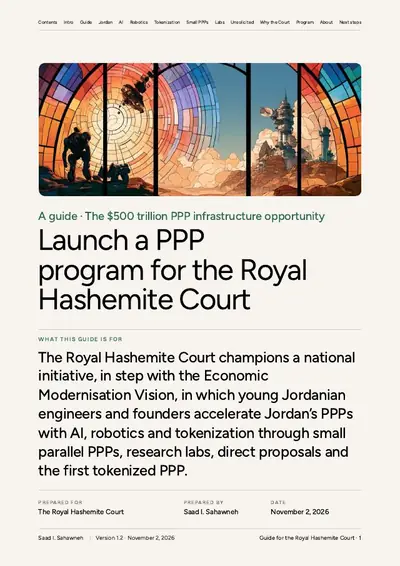
01 · National leadership
Royal Hashemite Court
Artificial intelligence
A national initiative can treat AI as shared public capacity. Open tools for preparing feasibility studies, comparing bids and reading contracts can serve every ministry at once, and young Jordanian engineers can build them on local data and local rates. The same tools let the public follow each project from preparation to operation in plain language.
Sector guides
Every sector guide shows what artificial intelligence changes in its sector on the way to the singularity
Jordan’s $86 billion is spread across 23 sectors. Each free sector guide lists every project in its sector and shows how to take part.
 Oil, Gas and Power$15.1bnThe bridge fuels that keep the lights on while a new energy system is built.23 projects
 Tourism$13.8bnAncient places and new destinations in a world with more time to travel.56 projects
 Urban Development$12.8bnNew cities and renewed centers designed to run on intelligence.30 projects
 Green Hydrogen$10.6bnDesert sunlight and wind turned into fuel the world can ship.12 projects
 Transport$8.1bnRoads, rails and runways becoming one intelligent network.32 projects
 Water$6.7bnTurning seawater, sunlight and software into a secure supply for a dry country.29 projects
More on the singularity
 The infrastructure singularityThe $500 trillion rebuild
 Futureproof your organizationWhat changes, and where to start
 RoboticsBuilds the assets and keeps them running
 TokenizationFinances the assets and opens ownership
 Small PPPs and research labsMany small projects, run in parallel
 Unsolicited proposalsTake your own PPP idea to government

New guide
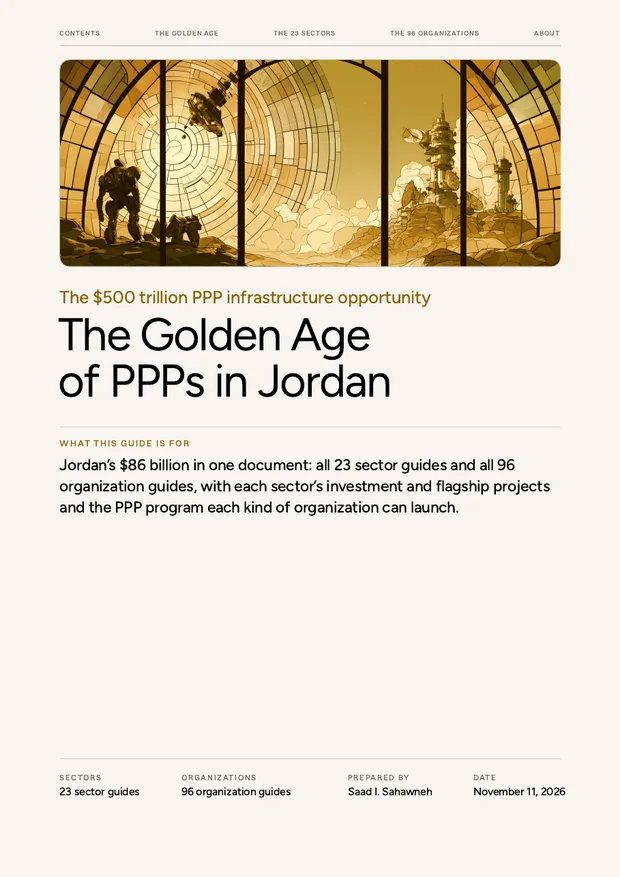
The golden age of PPPs in Jordan
All 23 sector guides and all 96 organization guides in one free guide to Jordan’s $86 billion.

Presentations
Book a Jordan PPP presentation for your organization
We give it online worldwide, or in person in Jordan, on the days and at the times that suit your team.
Book a presentation