
Operators and services
Launch a PPP program for Hospital Groups in Jordan
A free 17-page guide · The $500 trillion PPP infrastructure opportunity
What this guide is for
Your group launches a PPP program to build, equip and run public hospitals, clinics and medical centers, manage their clinical and non-clinical services and grow medical tourism.
The case
Hospital groups decide the care a health PPP delivers
Governments build and run most public hospitals and clinics themselves, while demand for care keeps growing with the population. The hospitals of the next fifty years will be built, equipped and run with private partners paid for the service they deliver, and the groups that run them will hold contracts as long as the concessions. This guide invites hospital groups in Jordan to launch a PPP program, starting with the projects at home.
The guide
Run the hospitals of the $500 trillion PPP opportunity
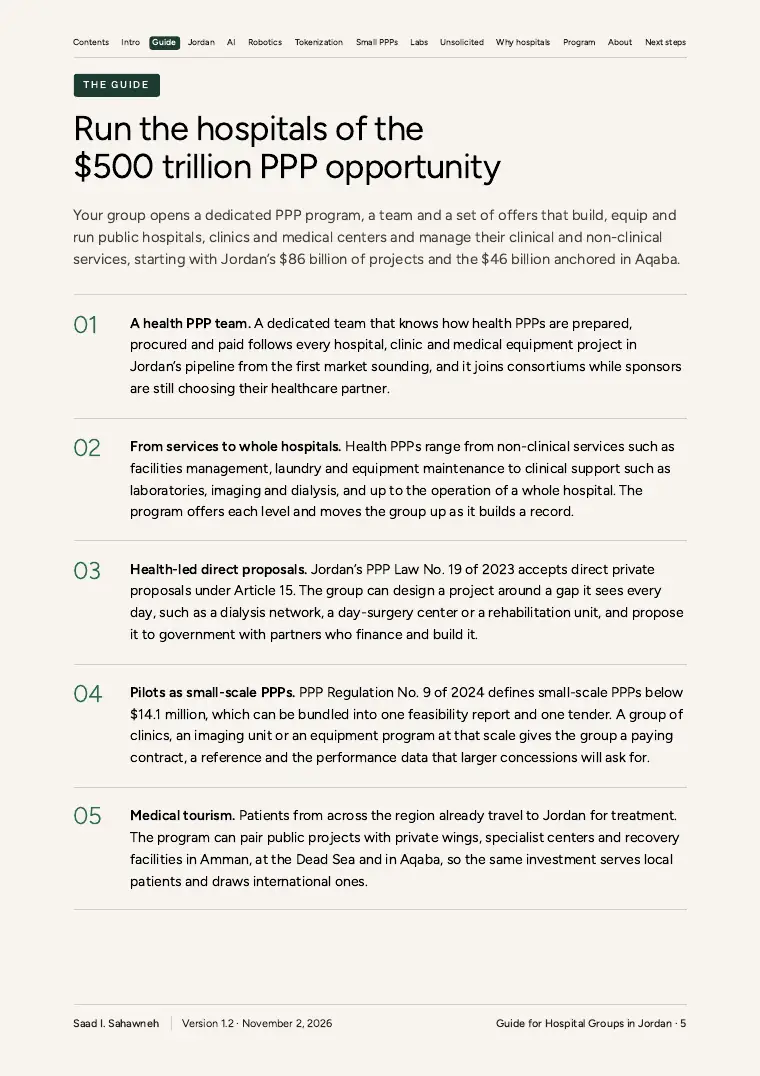
Your group opens a dedicated PPP program, a team and a set of offers that build, equip and run public hospitals, clinics and medical centers and manage their clinical and non-clinical services, starting with Jordan’s $86 billion of projects and the $46 billion anchored in Aqaba.
01
A health PPP team
A dedicated team that knows how health PPPs are prepared, procured and paid follows every hospital, clinic and medical equipment project in Jordan’s pipeline from the first market sounding, and it joins consortiums while sponsors are still choosing their healthcare partner.
02
From services to whole hospitals
Health PPPs range from non-clinical services such as facilities management, laundry and equipment maintenance to clinical support such as laboratories, imaging and dialysis, and up to the operation of a whole hospital. The program offers each level and moves the group up as it builds a record.
03
Health-led direct proposals
Jordan’s PPP Law No. 19 of 2023 accepts direct private proposals under Article 15. The group can design a project around a gap it sees every day, such as a dialysis network, a day-surgery center or a rehabilitation unit, and propose it to government with partners who finance and build it.
04
Pilots as small-scale PPPs
PPP Regulation No. 9 of 2024 defines small-scale PPPs below $14.1 million, which can be bundled into one feasibility report and one tender. A group of clinics, an imaging unit or an equipment program at that scale gives the group a paying contract, a reference and the performance data that larger concessions will ask for.
05
Medical tourism
Patients from across the region already travel to Jordan for treatment. The program can pair public projects with private wings, specialist centers and recovery facilities in Amman, at the Dead Sea and in Aqaba, so the same investment serves local patients and draws international ones.
Why hospital groups
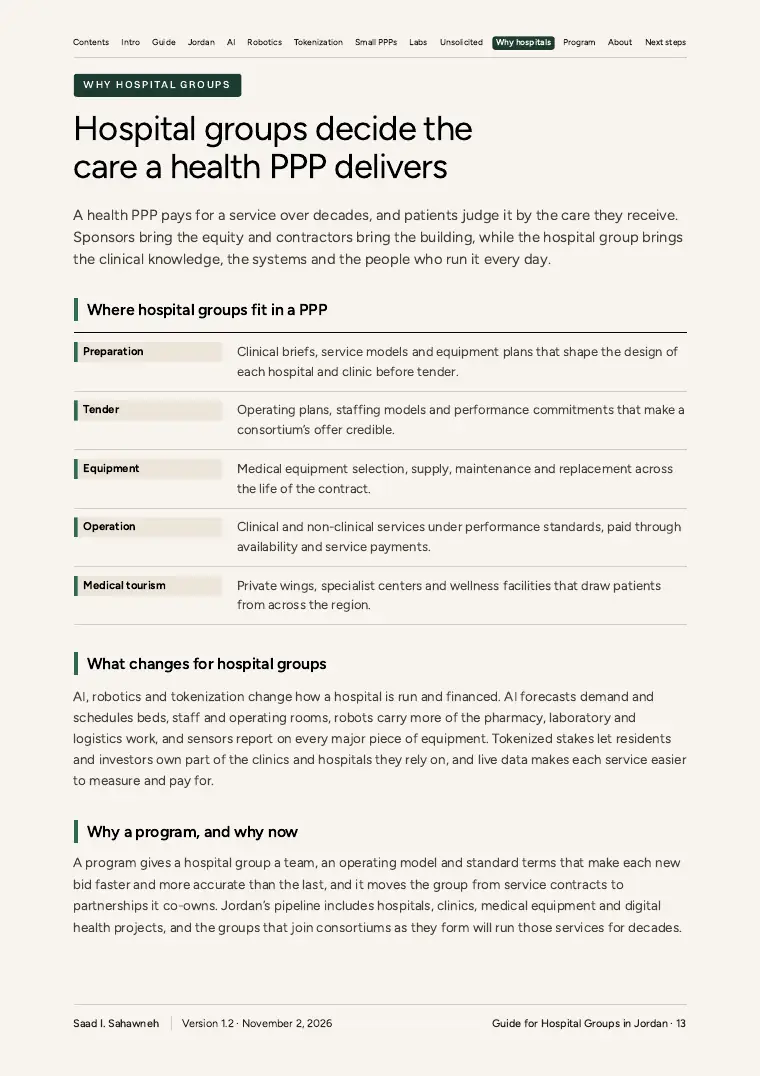
Hospital groups decide the care a health PPP delivers
A health PPP pays for a service over decades, and patients judge it by the care they receive. Sponsors bring the equity and contractors bring the building, while the hospital group brings the clinical knowledge, the systems and the people who run it every day.
Where hospital groups fit in a PPP
- Preparation
- Clinical briefs, service models and equipment plans that shape the design of each hospital and clinic before tender.
- Tender
- Operating plans, staffing models and performance commitments that make a consortium’s offer credible.
- Equipment
- Medical equipment selection, supply, maintenance and replacement across the life of the contract.
- Operation
- Clinical and non-clinical services under performance standards, paid through availability and service payments.
- Medical tourism
- Private wings, specialist centers and wellness facilities that draw patients from across the region.
What changes for hospital groups
AI, robotics and tokenization change how a hospital is run and financed. AI forecasts demand and schedules beds, staff and operating rooms, robots carry more of the pharmacy, laboratory and logistics work, and sensors report on every major piece of equipment. Tokenized stakes let residents and investors own part of the clinics and hospitals they rely on, and live data makes each service easier to measure and pay for.
Why a program, and why now
A program gives a hospital group a team, an operating model and standard terms that make each new bid faster and more accurate than the last, and it moves the group from service contracts to partnerships it co-owns. Jordan’s pipeline includes hospitals, clinics, medical equipment and digital health projects, and the groups that join consortiums as they form will run those services for decades.

Futureproofing
Futureproof Hospital Groups in Jordan for the infrastructure singularity
This free 17-page guide shows how, with small PPPs in parallel, PPP research labs, artificial intelligence, robotics, tokenization and six first steps.

Jordan and Aqaba
An $86 billion pipeline to start with
The hospitals, clinics and medical equipment programs among them will need partners that can equip and run them for decades. A Jordanian hospital group that runs one health PPP at home can carry the same model and teams to the next one across the region.
- $86B
- of PPP and infrastructure projects in development in Jordan
- $46B
- of them anchored in Aqaba

Artificial intelligence
AI is already entering clinical care through imaging, triage and patient records, and a PPP extends it to the hospital as an asset. A hospital group can use AI to forecast demand, schedule beds, staff and operating rooms, manage stock and predict equipment failures, so it meets the performance standards a health PPP pays for and prices each bid on real data.

Robotics
Robots already assist surgeons, dispense medicines and move supplies through hospital corridors. A hospital group can bring that automation into the services of a PPP hospital, from pharmacy and laboratory automation to disinfection and logistics robots, and use modular construction to bring new clinics into service sooner.

Tokenization
A health PPP earns availability payments from government for decades, the kind of steady cash flow a token represents well. A hospital group can offer tokenized stakes in its PPP clinics and hospitals to Jordanian and regional investors and the diaspora, pay holders as the payments arrive and record each asset’s performance on the same registry.

Small PPPs and research labs
Small PPPs let a hospital group test new models of care at low risk, from AI triage and remote monitoring to robotic pharmacies and modular clinics. A health lab inside the group can run these pilots in a handful of clinics, publish what works and give the group the evidence it needs before the same model reaches a large hospital tender.

Unsolicited proposals
A hospital group sees every day where patients wait, travel far or go without care. A direct proposal lets it turn that knowledge into a project of its own design, such as a regional imaging network or a home care service, protect the clinical model behind it and keep the right to match the best offer if the project goes to tender.
The program
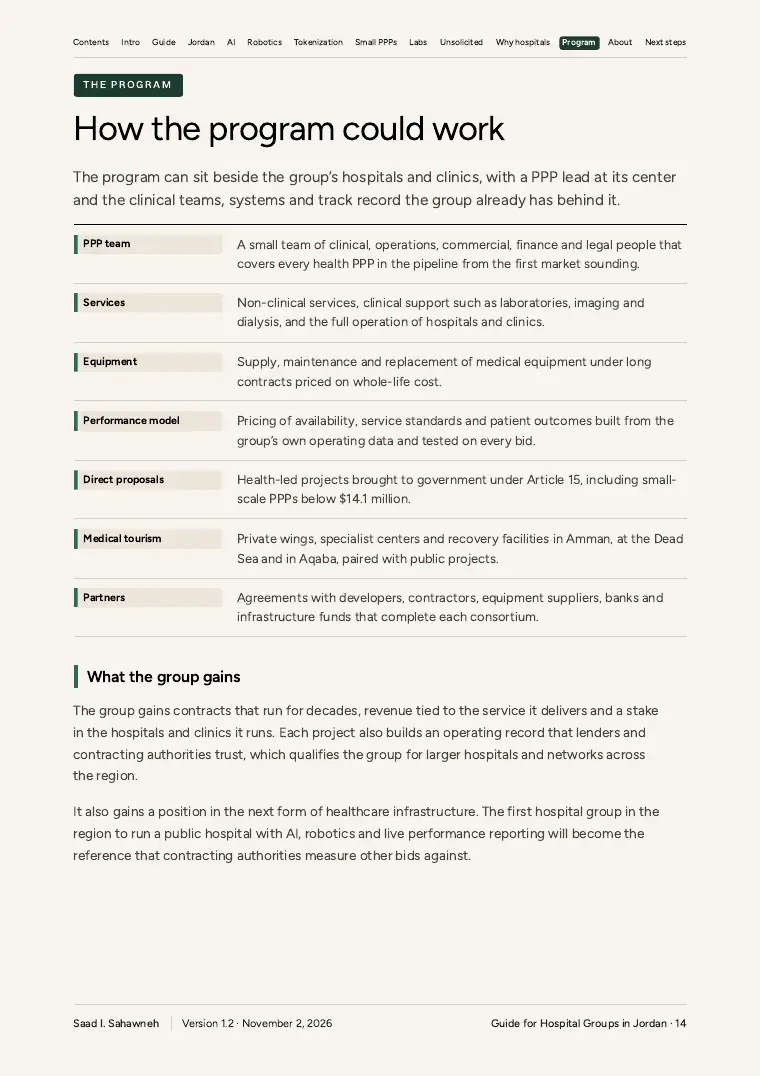
How the program could work
The program can sit beside the group’s hospitals and clinics, with a PPP lead at its center and the clinical teams, systems and track record the group already has behind it.
- PPP team
- A small team of clinical, operations, commercial, finance and legal people that covers every health PPP in the pipeline from the first market sounding.
- Services
- Non-clinical services, clinical support such as laboratories, imaging and dialysis, and the full operation of hospitals and clinics.
- Equipment
- Supply, maintenance and replacement of medical equipment under long contracts priced on whole-life cost.
- Performance model
- Pricing of availability, service standards and patient outcomes built from the group’s own operating data and tested on every bid.
- Direct proposals
- Health-led projects brought to government under Article 15, including small-scale PPPs below $14.1 million.
- Medical tourism
- Private wings, specialist centers and recovery facilities in Amman, at the Dead Sea and in Aqaba, paired with public projects.
- Partners
- Agreements with developers, contractors, equipment suppliers, banks and infrastructure funds that complete each consortium.
What the group gains
The group gains contracts that run for decades, revenue tied to the service it delivers and a stake in the hospitals and clinics it runs. Each project also builds an operating record that lenders and contracting authorities trust, which qualifies the group for larger hospitals and networks across the region.
It also gains a position in the next form of healthcare infrastructure. The first hospital group in the region to run a public hospital with AI, robotics and live performance reporting will become the reference that contracting authorities measure other bids against.

Next steps
How a hospital group can start
Any hospital group in Jordan can take this guide forward. The first steps use the hospitals, clinical teams and systems the group already has.
01
Mandate
Board approval for a health PPP program, with its services, the contracts it will bid for and its first-year goals.
02
Team
A named program lead, with clinical, operations, commercial, finance and legal people drawn from the group’s existing teams.
03
Pipeline
A map of the hospitals, clinics, equipment and digital health projects in Jordan’s $86 billion pipeline, and early meetings with the contracting authorities that will tender them.
04
Services
The clinical and non-clinical services, equipment and systems the group will bring to its first bids.
05
Partners
Developers, contractors, equipment suppliers, banks and technology companies to complete each consortium.
06
Pilot
A first service contract, small-scale PPP or direct proposal, taken from idea to submission.
Jordan has the projects, a health sector that already treats patients from across the region and a law that accepts unsolicited proposals. A PPP program gives your group the contracts to run public hospitals and clinics and a head start in delivering care inside the superintelligent infrastructure future.
The full document
Inside this guide
Seventeen pages and thirteen sections, from the case for a PPP program to the first steps, written for hospital groups in Jordan.
Download the guide (PDF)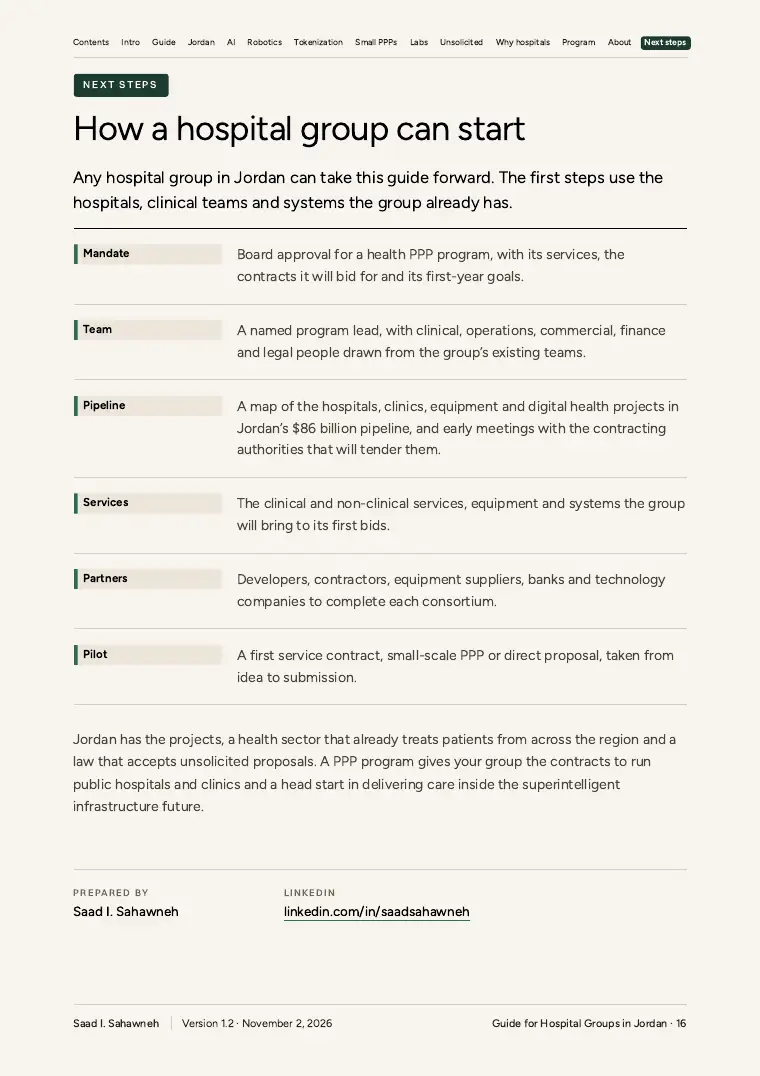
- 01IntroductionWhy a century of infrastructure needs rebuilding, and the $500 trillion it will take.p. 3
- 02The guideRun the hospitals of the $500 trillion PPP opportunityp. 5
- 03Jordan and AqabaAn $86 billion pipeline to start withp. 6
- 04Artificial intelligenceHow AI designs, structures and runs PPP projects, and what it means for hospital groups.p. 7
- 05RoboticsHow robots build infrastructure and keep it running, and what that means for hospital groups.p. 8
- 06TokenizationHow tokenization funds projects from their own revenue, and the role it opens for hospital groups.p. 9
- 07Small PPPs in parallelWhy many small PPPs teach a country faster than a few large ones.p. 10
- 08PPP research labsA lab in each sector, running ten small PPP projects a year.p. 11
- 09Unsolicited proposalsHow Jordan’s PPP law accepts direct proposals from private companies.p. 12
- 10Why hospital groupsHospital groups decide the care a health PPP deliversp. 13
- 11The programThe program can sit beside the group’s hospitals and clinics, with a PPP lead at its center and the clinical teams, systems and track record the group already has behind it.p. 14
- 12AboutAbout Jordan PPP and what it offers.p. 15
- 13Next stepsHow a hospital group can start: six first steps.p. 16
Questions
Questions about the guide for Hospital Groups in Jordan
- What does the guide for Hospital Groups in Jordan propose?
- Your group launches a PPP program to build, equip and run public hospitals, clinics and medical centers, manage their clinical and non-clinical services and grow medical tourism.
- Why should hospital groups in Jordan launch a PPP program?
- Hospital groups decide the care a health PPP delivers. A health PPP pays for a service over decades, and patients judge it by the care they receive. Sponsors bring the equity and contractors bring the building, while the hospital group brings the clinical knowledge, the systems and the people who run it every day.
- Which PPP projects can hospital groups in Jordan take part in?
- Jordan has about $86 billion of PPP and infrastructure projects in development, $46 billion of them anchored in Aqaba. The hospitals, clinics and medical equipment programs among them will need partners that can equip and run them for decades. A Jordanian hospital group that runs one health PPP at home can carry the same model and teams to the next one across the region.
- How can hospital groups in Jordan start a PPP program?
- Any hospital group in Jordan can take this guide forward. The first steps use the hospitals, clinical teams and systems the group already has. The guide sets out six first steps: mandate, team, pipeline, services, partners and pilot.
- What does a PPP program give hospital groups in Jordan?
- The group gains contracts that run for decades, revenue tied to the service it delivers and a stake in the hospitals and clinics it runs. Each project also builds an operating record that lenders and contracting authorities trust, which qualifies the group for larger hospitals and networks across the region.
- Is the guide for Hospital Groups in Jordan free?
- Yes. It is free to read on this page and free to download as a 17-page PDF, with the case for a PPP program, Jordan’s pipeline, the role of AI, robotics and tokenization, the program and six first steps.
Guide 27 of 52
Browse all 52 guides