
Advisors and professional bodies
Launch a PPP program for Professional Bodies and Chambers in Jordan
A free 17-page guide · The $500 trillion PPP infrastructure opportunity
What this guide is for
Your association or chamber launches a public-private partnership (PPP) program for its members, with training and certification, a small-PPP tier that prepares smaller firms to prequalify, standard templates and consortium matchmaking.
The case
Professional bodies and chambers reach the firms that will build the pipeline
Many of the firms that will design, build, supply and maintain Jordan’s next generation of infrastructure belong to a professional body or a chamber, and most of them are small. A large PPP tender asks for a decade of comparable projects that few small firms can show on their own. A member body can train its members, give them standard tools and bring them together into consortiums that qualify. This guide invites professional bodies and chambers in Jordan to launch a PPP program for their members, starting with the projects at home.
The guide
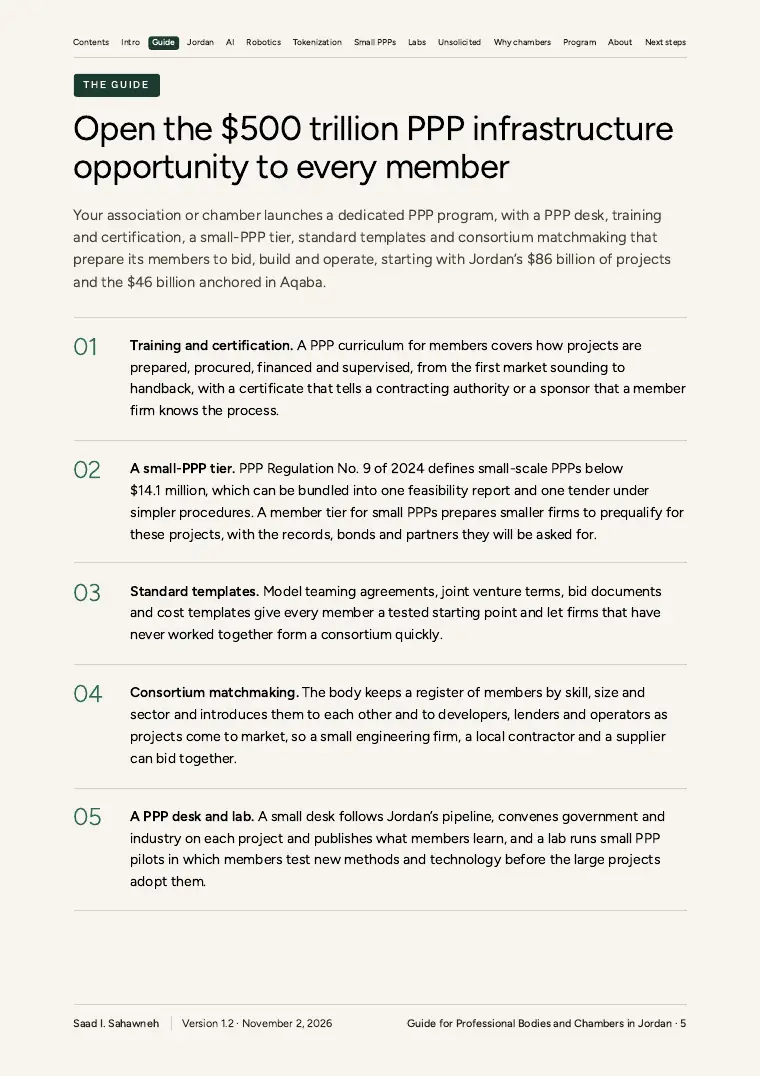
Open the $500 trillion PPP infrastructure opportunity to every member
Your association or chamber launches a dedicated PPP program, with a PPP desk, training and certification, a small-PPP tier, standard templates and consortium matchmaking that prepare its members to bid, build and operate, starting with Jordan’s $86 billion of projects and the $46 billion anchored in Aqaba.
01
Training and certification
A PPP curriculum for members covers how projects are prepared, procured, financed and supervised, from the first market sounding to handback, with a certificate that tells a contracting authority or a sponsor that a member firm knows the process.
02
A small-PPP tier
PPP Regulation No. 9 of 2024 defines small-scale PPPs below $14.1 million, which can be bundled into one feasibility report and one tender under simpler procedures. A member tier for small PPPs prepares smaller firms to prequalify for these projects, with the records, bonds and partners they will be asked for.
03
Standard templates
Model teaming agreements, joint venture terms, bid documents and cost templates give every member a tested starting point and let firms that have never worked together form a consortium quickly.
04
Consortium matchmaking
The body keeps a register of members by skill, size and sector and introduces them to each other and to developers, lenders and operators as projects come to market, so a small engineering firm, a local contractor and a supplier can bid together.
05
A PPP desk and lab
A small desk follows Jordan’s pipeline, convenes government and industry on each project and publishes what members learn, and a lab runs small PPP pilots in which members test new methods and technology before the large projects adopt them.
Why professional bodies and chambers
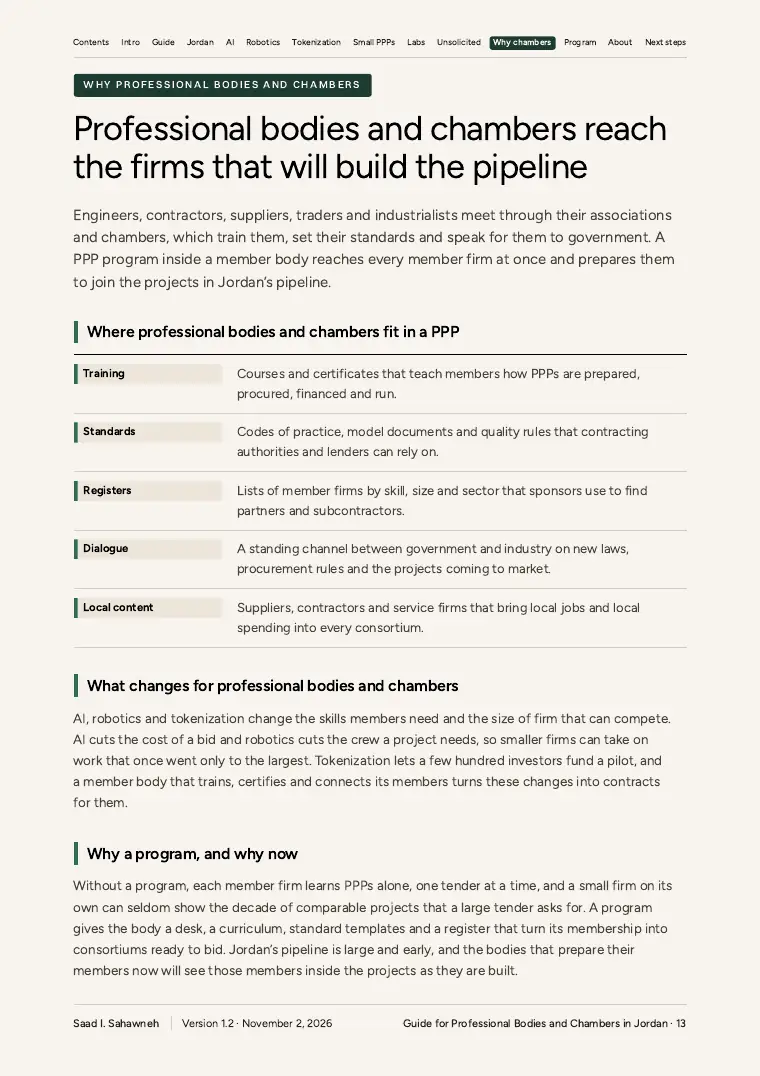
Professional bodies and chambers reach the firms that will build the pipeline
Engineers, contractors, suppliers, traders and industrialists meet through their associations and chambers, which train them, set their standards and speak for them to government. A PPP program inside a member body reaches every member firm at once and prepares them to join the projects in Jordan’s pipeline.
Where professional bodies and chambers fit in a PPP
- Training
- Courses and certificates that teach members how PPPs are prepared, procured, financed and run.
- Standards
- Codes of practice, model documents and quality rules that contracting authorities and lenders can rely on.
- Registers
- Lists of member firms by skill, size and sector that sponsors use to find partners and subcontractors.
- Dialogue
- A standing channel between government and industry on new laws, procurement rules and the projects coming to market.
- Local content
- Suppliers, contractors and service firms that bring local jobs and local spending into every consortium.
What changes for professional bodies and chambers
AI, robotics and tokenization change the skills members need and the size of firm that can compete. AI cuts the cost of a bid and robotics cuts the crew a project needs, so smaller firms can take on work that once went only to the largest. Tokenization lets a few hundred investors fund a pilot, and a member body that trains, certifies and connects its members turns these changes into contracts for them.
Why a program, and why now
Without a program, each member firm learns PPPs alone, one tender at a time, and a small firm on its own can seldom show the decade of comparable projects that a large tender asks for. A program gives the body a desk, a curriculum, standard templates and a register that turn its membership into consortiums ready to bid. Jordan’s pipeline is large and early, and the bodies that prepare their members now will see those members inside the projects as they are built.

Futureproofing
Futureproof Professional Bodies and Chambers in Jordan for the infrastructure singularity
This free 17-page guide shows how, with small PPPs in parallel, PPP research labs, artificial intelligence, robotics, tokenization and six first steps.

Jordan and Aqaba
An $86 billion pipeline to start with
Each of them will need engineers, contractors, suppliers and service firms, and many of those firms belong to a professional body or a chamber. A member firm that delivers one PPP at home can carry the same model to the next project across the region, and its professional body can pass the lessons to every other member.
- $86B
- of PPP and infrastructure projects in development in Jordan
- $46B
- of them anchored in Aqaba

Artificial intelligence
AI lowers the cost of a bid to a level that smaller member firms can afford. A small firm can read a tender, draft its technical offer, price its scope against real rates and check a contract in days, work that once needed a large bid team. A member body can offer these tools to all its members at once and teach them to use the tools well.

Robotics
Robotics changes what a small member firm can take on. Drones survey sites and inspect roads, bridges and power lines, modular methods and on-site automation cut the crew a project needs, and crawlers inspect pipes and tanks, so a firm with a small team and the right machines can deliver work that once needed a far larger one. Member bodies can set the training and safety standards for this work and certify the people who do it.

Tokenization
Tokenization lets members and their clients invest in the projects their firms build. A small PPP can raise its capital from a few hundred investors and pay them from the asset’s own revenue, so a consortium of member firms can fund a pilot without waiting for a large lender, and a member body can teach its members how tokenized projects are structured, disclosed and run.

Small PPPs and research labs
Small PPPs are where most member firms can enter the market, because the projects are sized to the firms. A professional body or chamber can run a lab of small pilots with its members, test new methods, AI tools and robotics on live projects, publish every result, including the failures, and carry what works into its training and templates.

Unsolicited proposals
Members see where a public service falls short every day, on the sites, in the plants and in the streets where they work. A direct proposal lets a member firm, or a consortium formed through the body, turn that knowledge into a project of its own design and keep the right to match the best offer if the project goes to tender. A member body can teach its members how to prepare a proposal and bring the strongest ideas to government.
The program
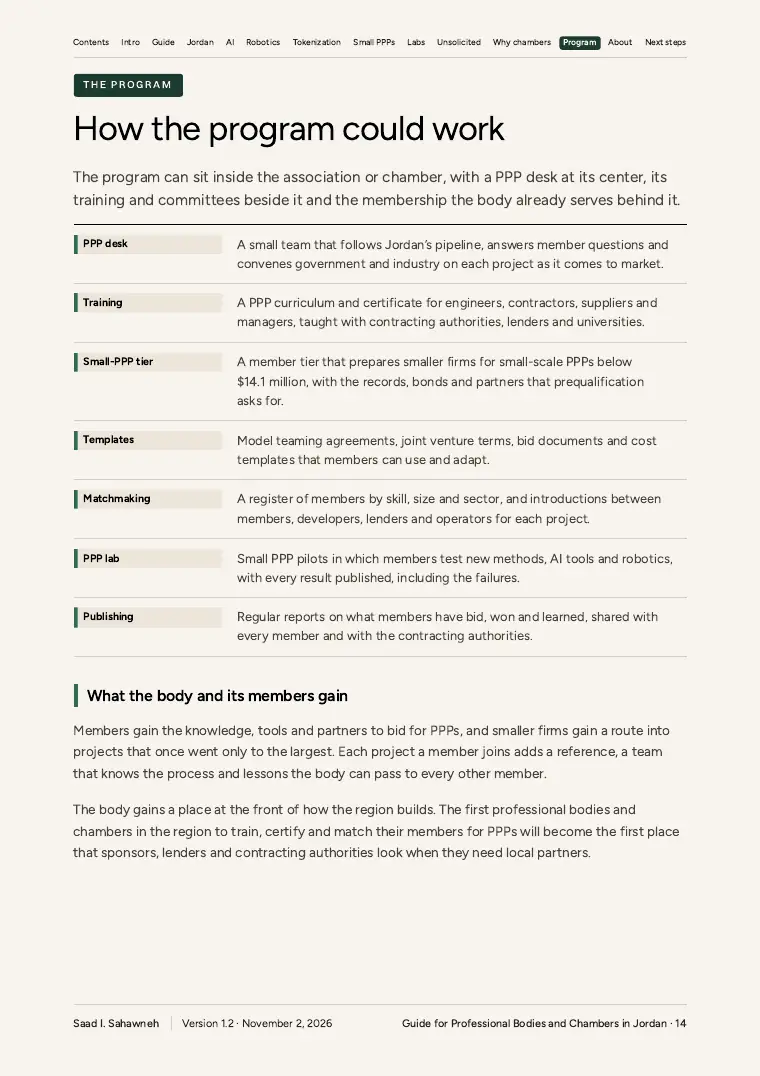
How the program could work
The program can sit inside the association or chamber, with a PPP desk at its center, its training and committees beside it and the membership the body already serves behind it.
- PPP desk
- A small team that follows Jordan’s pipeline, answers member questions and convenes government and industry on each project as it comes to market.
- Training
- A PPP curriculum and certificate for engineers, contractors, suppliers and managers, taught with contracting authorities, lenders and universities.
- Small-PPP tier
- A member tier that prepares smaller firms for small-scale PPPs below $14.1 million, with the records, bonds and partners that prequalification asks for.
- Templates
- Model teaming agreements, joint venture terms, bid documents and cost templates that members can use and adapt.
- Matchmaking
- A register of members by skill, size and sector, and introductions between members, developers, lenders and operators for each project.
- PPP lab
- Small PPP pilots in which members test new methods, AI tools and robotics, with every result published, including the failures.
- Publishing
- Regular reports on what members have bid, won and learned, shared with every member and with the contracting authorities.
What the body and its members gain
Members gain the knowledge, tools and partners to bid for PPPs, and smaller firms gain a route into projects that once went only to the largest. Each project a member joins adds a reference, a team that knows the process and lessons the body can pass to every other member.
The body gains a place at the front of how the region builds. The first professional bodies and chambers in the region to train, certify and match their members for PPPs will become the first place that sponsors, lenders and contracting authorities look when they need local partners.

Next steps
How a professional body or chamber can start
Any professional body or chamber in Jordan can take this guide forward. The first steps use the members, committees and training the body already has.
01
Mandate
A decision by the council or board to launch a PPP program for members, with its sectors, its member services and its first-year goals.
02
Team
A named program lead, with a small PPP desk drawn from the body’s staff, committees and experienced members.
03
Pipeline
A map of Jordan’s $86 billion of projects by sector and stage, matched to the member firms that can design, build, supply or run each one.
04
Small-PPP tier
A first curriculum, certificate and member tier for small-scale PPPs, with standard templates members can use on their first bids.
05
Partners
Contracting authorities, developers, lenders, operators and universities that will teach, sponsor and join member consortiums.
06
Pilot
A first member consortium, formed through the desk and taken from idea to a small-scale PPP bid or direct proposal.
Jordan has the projects, rules that make small PPPs simpler to tender and a law that accepts unsolicited proposals. A PPP program gives your association or chamber the desk, the training and the consortiums to bring its members into those projects and into the superintelligent infrastructure future.
The full document
Inside this guide
Seventeen pages and thirteen sections, from the case for a PPP program to the first steps, written for professional bodies and chambers in Jordan.
Download the guide (PDF)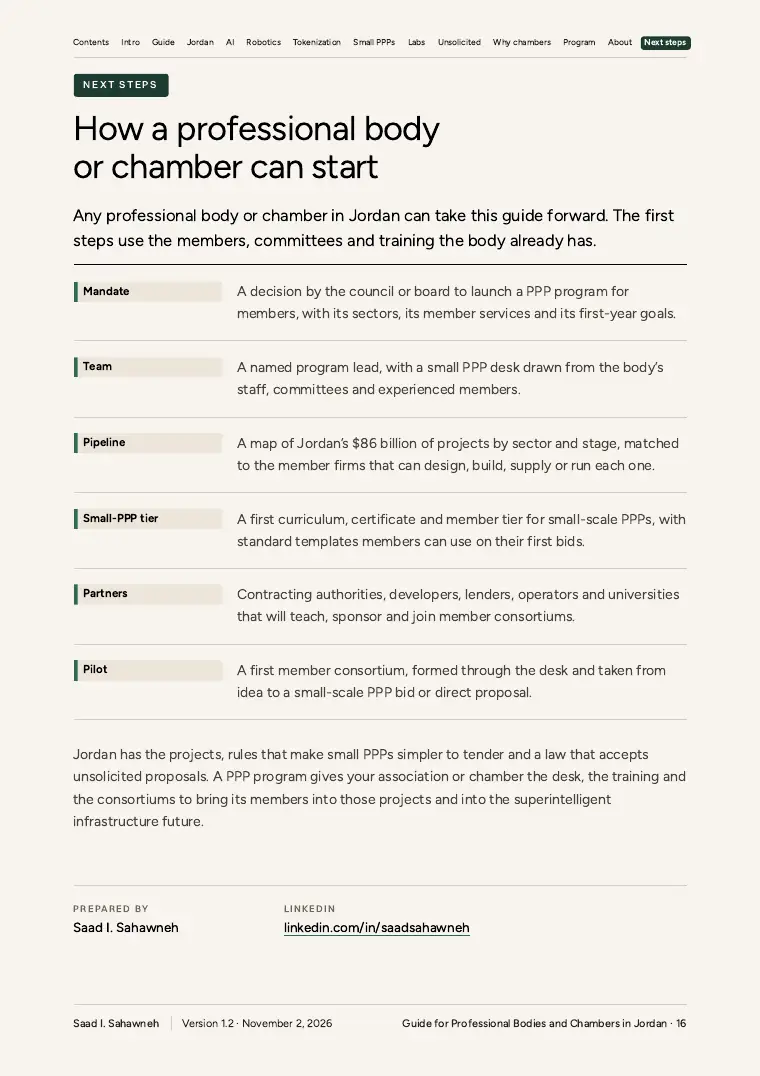
- 01IntroductionWhy a century of infrastructure needs rebuilding, and the $500 trillion it will take.p. 3
- 02The guideOpen the $500 trillion PPP infrastructure opportunity to every memberp. 5
- 03Jordan and AqabaAn $86 billion pipeline to start withp. 6
- 04Artificial intelligenceHow AI designs, structures and runs PPP projects, and what it means for professional bodies and chambers.p. 7
- 05RoboticsHow robots build infrastructure and keep it running, and what that means for professional bodies and chambers.p. 8
- 06TokenizationHow tokenization funds projects from their own revenue, and the role it opens for professional bodies and chambers.p. 9
- 07Small PPPs in parallelWhy many small PPPs teach a country faster than a few large ones.p. 10
- 08PPP research labsA lab in each sector, running ten small PPP projects a year.p. 11
- 09Unsolicited proposalsHow Jordan’s PPP law accepts direct proposals from private companies.p. 12
- 10Why professional bodies and chambersProfessional bodies and chambers reach the firms that will build the pipelinep. 13
- 11The programThe program can sit inside the association or chamber, with a PPP desk at its center, its training and committees beside it and the membership the body already serves behind it.p. 14
- 12AboutAbout Jordan PPP and what it offers.p. 15
- 13Next stepsHow a professional body or chamber can start: six first steps.p. 16
Questions
Questions about the guide for Professional Bodies and Chambers in Jordan
- What does the guide for Professional Bodies and Chambers in Jordan propose?
- Your association or chamber launches a public-private partnership (PPP) program for its members, with training and certification, a small-PPP tier that prepares smaller firms to prequalify, standard templates and consortium matchmaking.
- Why should professional bodies and chambers in Jordan launch a PPP program?
- Professional bodies and chambers reach the firms that will build the pipeline. Engineers, contractors, suppliers, traders and industrialists meet through their associations and chambers, which train them, set their standards and speak for them to government. A PPP program inside a member body reaches every member firm at once and prepares them to join the projects in Jordan’s pipeline.
- Which PPP projects can professional bodies and chambers in Jordan take part in?
- Jordan has about $86 billion of PPP and infrastructure projects in development, $46 billion of them anchored in Aqaba. Each of them will need engineers, contractors, suppliers and service firms, and many of those firms belong to a professional body or a chamber. A member firm that delivers one PPP at home can carry the same model to the next project across the region, and its professional body can pass the lessons to every other member.
- How can professional bodies and chambers in Jordan start a PPP program?
- Any professional body or chamber in Jordan can take this guide forward. The first steps use the members, committees and training the body already has. The guide sets out six first steps: mandate, team, pipeline, small-PPP tier, partners and pilot.
- What does a PPP program give professional bodies and chambers in Jordan?
- Members gain the knowledge, tools and partners to bid for PPPs, and smaller firms gain a route into projects that once went only to the largest. Each project a member joins adds a reference, a team that knows the process and lessons the body can pass to every other member.
- Is the guide for Professional Bodies and Chambers in Jordan free?
- Yes. It is free to read on this page and free to download as a 17-page PDF, with the case for a PPP program, Jordan’s pipeline, the role of AI, robotics and tokenization, the program and six first steps.
Guide 22 of 52
Browse all 52 guides