
Humanitarian and relief
Launch a PPP program for Social Enterprises and Impact Companies in Jordan
A free 17-page guide · The $500 trillion PPP infrastructure opportunity
What this guide is for
Your company launches a public-private partnership (PPP) program that turns its services for people in need into small PPPs and direct proposals in water, energy, waste, education and health, financed with impact investment.
The case
Social enterprises see the need first and build the fix
Social enterprises and impact companies in Jordan already deliver clean water, solar power, recycling, learning and care to communities that larger companies overlook. Most of them sell project by project, grant by grant. Small PPPs give them long-term contracts with public partners, paid for the results they deliver, and a route to bring their own ideas to government. This guide invites social enterprises and impact companies in Jordan to launch a PPP program, starting with the communities they serve.
The guide
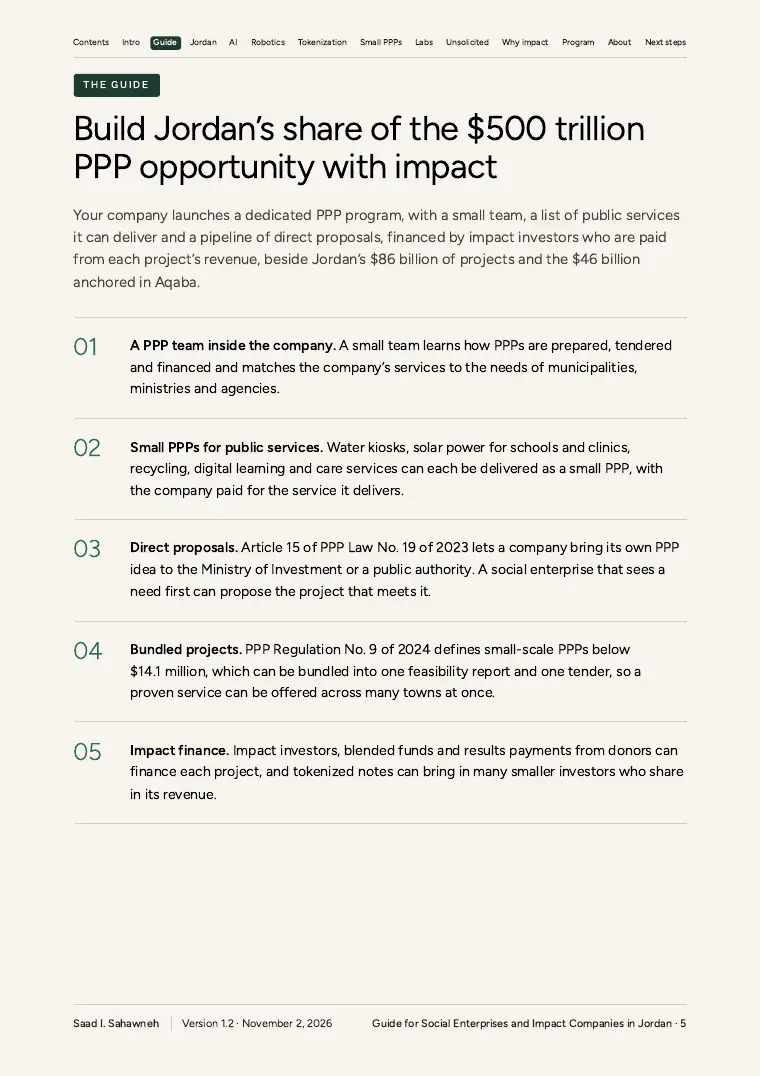
Build Jordan’s share of the $500 trillion PPP opportunity with impact
Your company launches a dedicated PPP program, with a small team, a list of public services it can deliver and a pipeline of direct proposals, financed by impact investors who are paid from each project’s revenue, beside Jordan’s $86 billion of projects and the $46 billion anchored in Aqaba.
01
A PPP team inside the company
A small team learns how PPPs are prepared, tendered and financed and matches the company’s services to the needs of municipalities, ministries and agencies.
02
Small PPPs for public services
Water kiosks, solar power for schools and clinics, recycling, digital learning and care services can each be delivered as a small PPP, with the company paid for the service it delivers.
03
Direct proposals
Article 15 of PPP Law No. 19 of 2023 lets a company bring its own PPP idea to the Ministry of Investment or a public authority. A social enterprise that sees a need first can propose the project that meets it.
04
Bundled projects
PPP Regulation No. 9 of 2024 defines small-scale PPPs below $14.1 million, which can be bundled into one feasibility report and one tender, so a proven service can be offered across many towns at once.
05
Impact finance
Impact investors, blended funds and results payments from donors can finance each project, and tokenized notes can bring in many smaller investors who share in its revenue.
Why social enterprises and impact companies
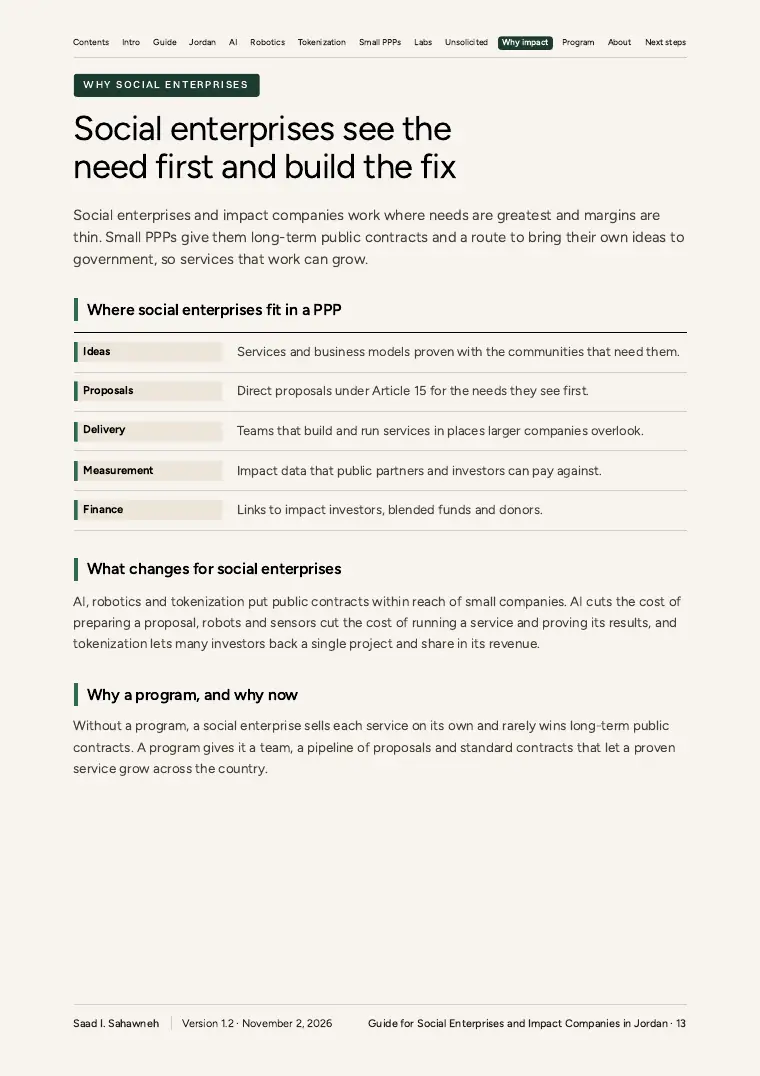
Social enterprises see the need first and build the fix
Social enterprises and impact companies work where needs are greatest and margins are thin. Small PPPs give them long-term public contracts and a route to bring their own ideas to government, so services that work can grow.
Where social enterprises fit in a PPP
- Ideas
- Services and business models proven with the communities that need them.
- Proposals
- Direct proposals under Article 15 for the needs they see first.
- Delivery
- Teams that build and run services in places larger companies overlook.
- Measurement
- Impact data that public partners and investors can pay against.
- Finance
- Links to impact investors, blended funds and donors.
What changes for social enterprises
AI, robotics and tokenization put public contracts within reach of small companies. AI cuts the cost of preparing a proposal, robots and sensors cut the cost of running a service and proving its results, and tokenization lets many investors back a single project and share in its revenue.
Why a program, and why now
Without a program, a social enterprise sells each service on its own and rarely wins long-term public contracts. A program gives it a team, a pipeline of proposals and standard contracts that let a proven service grow across the country.

Futureproofing
Futureproof Social Enterprises and Impact Companies in Jordan for the infrastructure singularity
This free 17-page guide shows how, with small PPPs in parallel, PPP research labs, artificial intelligence, robotics, tokenization and six first steps.

Jordan and Aqaba
An $86 billion pipeline to start with
Many of them will need the services, local knowledge and community trust that social enterprises bring. A service a social enterprise proves in one town can be offered across the country, and other companies can follow the same contract.
- $86B
- of PPP and infrastructure projects in development in Jordan
- $46B
- of them anchored in Aqaba

Artificial intelligence
AI lets a small company compete for public contracts. It can draft a direct proposal and its pre-feasibility study, model demand and cost, compare designs and read every contract in plain language. Once a service is running, sensors and AI measure the results that impact investors and public partners pay for.

Robotics
Robotics lets a small team deliver more. Automated recycling lines, solar-cleaning robots, drones that check water systems and sensors that report failures keep services running at low cost, and their records prove what was delivered.

Tokenization
Tokenization opens impact investing to many more people. A solar roof, a water kiosk network or a recycling plant that earns a steady payment can raise its capital from many investors in Jordan and abroad and pay them from its own revenue, with a public registry showing the impact and the returns.

Small PPPs and research labs
Small PPPs suit social enterprises because their services already come in small, repeatable units. A lab can test a water kiosk, a solar clinic or a recycling service in a few towns, publish every result and carry what works across the country, and each pilot gives impact investors the evidence they need.

Unsolicited proposals
Direct proposals let a social enterprise take its own idea to government, prepared at its own cost. A qualifying proposal enters the PPP Registry, and if the project goes to tender the proposer can match the best offer, while the winning bidder pays the proposer’s direct study costs, which protects the company’s early work.
The program
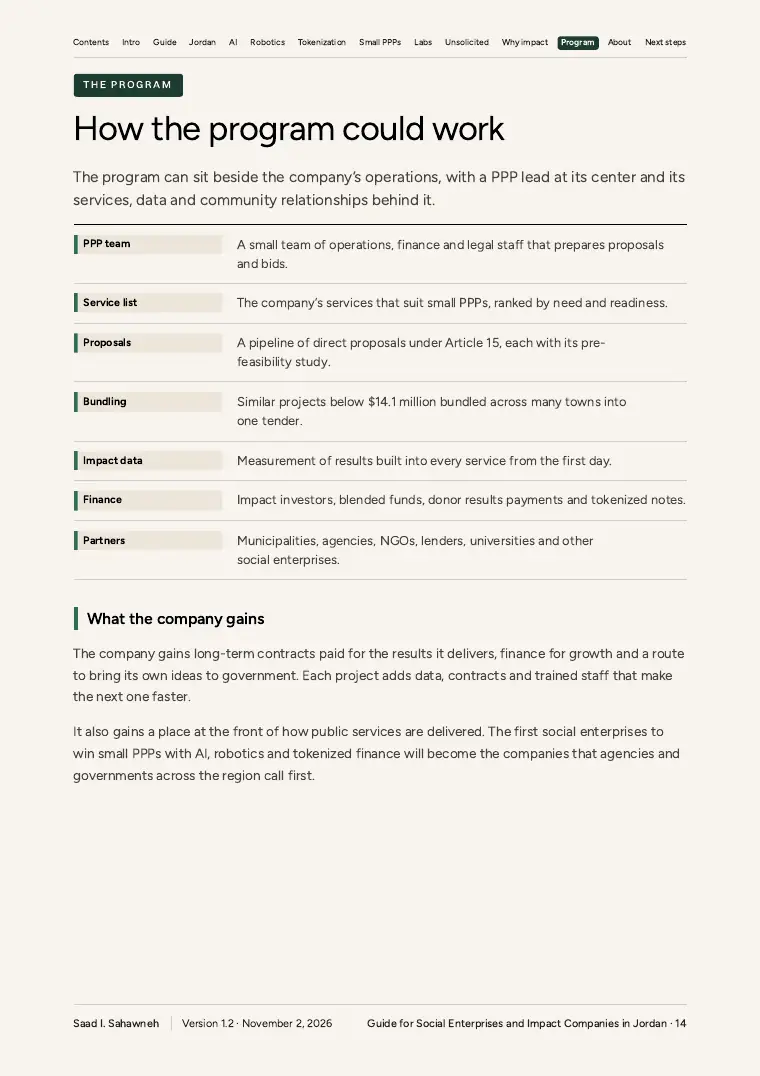
How the program could work
The program can sit beside the company’s operations, with a PPP lead at its center and its services, data and community relationships behind it.
- PPP team
- A small team of operations, finance and legal staff that prepares proposals and bids.
- Service list
- The company’s services that suit small PPPs, ranked by need and readiness.
- Proposals
- A pipeline of direct proposals under Article 15, each with its pre-feasibility study.
- Bundling
- Similar projects below $14.1 million bundled across many towns into one tender.
- Impact data
- Measurement of results built into every service from the first day.
- Finance
- Impact investors, blended funds, donor results payments and tokenized notes.
- Partners
- Municipalities, agencies, NGOs, lenders, universities and other social enterprises.
What the company gains
The company gains long-term contracts paid for the results it delivers, finance for growth and a route to bring its own ideas to government. Each project adds data, contracts and trained staff that make the next one faster.
It also gains a place at the front of how public services are delivered. The first social enterprises to win small PPPs with AI, robotics and tokenized finance will become the companies that agencies and governments across the region call first.

Next steps
How a social enterprise can start
Any social enterprise or impact company in Jordan can take this guide forward. The first steps use the services, data and relationships it already has.
01
Mandate
Founder or board approval for a PPP program, with its services, its first proposals and its first-year goals.
02
Team
A named PPP lead, with operations, finance and legal staff from the company’s existing team.
03
Pipeline
A map of the public needs the company can meet, and early meetings with the municipalities and authorities behind them.
04
Own offer
The services, technology and impact data the company brings to each project.
05
Partners
Impact investors, lenders, agencies, NGOs and other companies that complete each project.
06
Pilot
A first small-scale PPP or direct proposal, taken from idea to submission.
Jordan has the projects, a law that accepts unsolicited proposals and rules that make small PPPs simpler to tender. A PPP program gives your company long-term public contracts, finance for growth and a head start in building the superintelligent infrastructure future for the communities it serves.
The full document
Inside this guide
Seventeen pages and thirteen sections, from the case for a PPP program to the first steps, written for social enterprises and impact companies in Jordan.
Download the guide (PDF)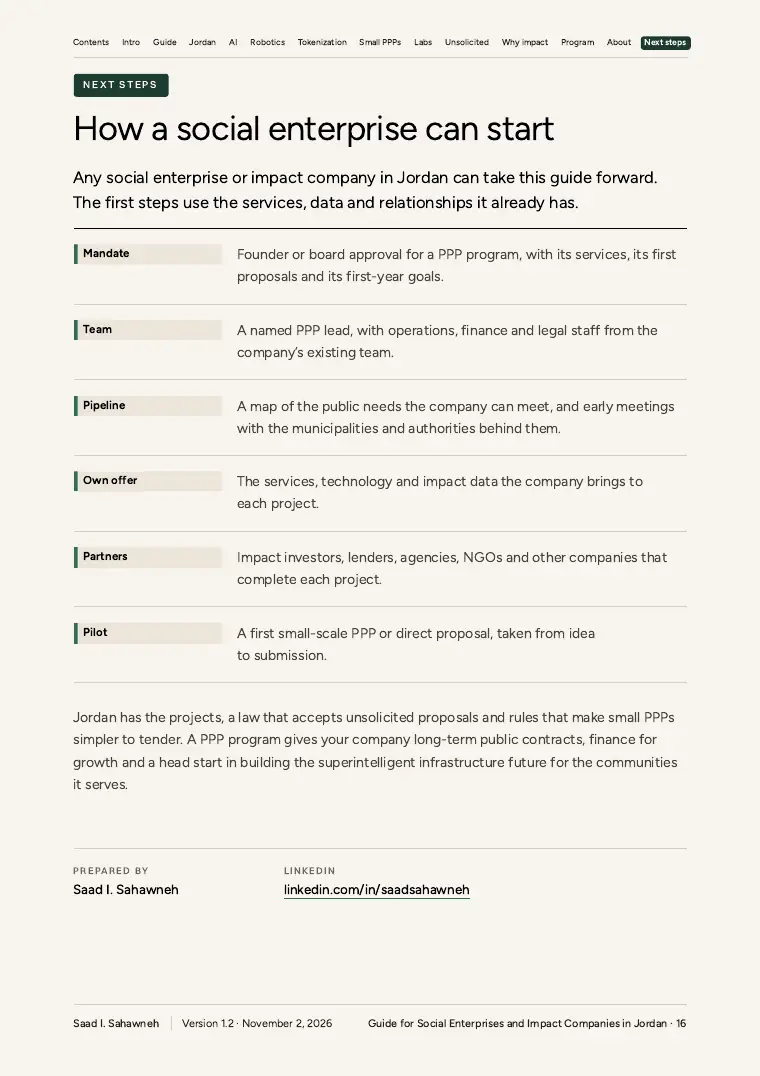
- 01IntroductionWhy a century of infrastructure needs rebuilding, and the $500 trillion it will take.p. 3
- 02The guideBuild Jordan’s share of the $500 trillion PPP opportunity with impactp. 5
- 03Jordan and AqabaAn $86 billion pipeline to start withp. 6
- 04Artificial intelligenceHow AI designs, structures and runs PPP projects, and what it means for social enterprises and impact companies.p. 7
- 05RoboticsHow robots build infrastructure and keep it running, and what that means for social enterprises and impact companies.p. 8
- 06TokenizationHow tokenization funds projects from their own revenue, and the role it opens for social enterprises and impact companies.p. 9
- 07Small PPPs in parallelWhy many small PPPs teach a country faster than a few large ones.p. 10
- 08PPP research labsA lab in each sector, running ten small PPP projects a year.p. 11
- 09Unsolicited proposalsHow Jordan’s PPP law accepts direct proposals from private companies.p. 12
- 10Why social enterprises and impact companiesSocial enterprises see the need first and build the fixp. 13
- 11The programThe program can sit beside the company’s operations, with a PPP lead at its center and its services, data and community relationships behind it.p. 14
- 12AboutAbout Jordan PPP and what it offers.p. 15
- 13Next stepsHow a social enterprise can start: six first steps.p. 16
Questions
Questions about the guide for Social Enterprises and Impact Companies in Jordan
- What does the guide for Social Enterprises and Impact Companies in Jordan propose?
- Your company launches a public-private partnership (PPP) program that turns its services for people in need into small PPPs and direct proposals in water, energy, waste, education and health, financed with impact investment.
- Why should social enterprises and impact companies in Jordan launch a PPP program?
- Social enterprises see the need first and build the fix. Social enterprises and impact companies work where needs are greatest and margins are thin. Small PPPs give them long-term public contracts and a route to bring their own ideas to government, so services that work can grow.
- Which PPP projects can social enterprises and impact companies in Jordan take part in?
- Jordan has about $86 billion of PPP and infrastructure projects in development, $46 billion of them anchored in Aqaba. Many of them will need the services, local knowledge and community trust that social enterprises bring. A service a social enterprise proves in one town can be offered across the country, and other companies can follow the same contract.
- How can social enterprises and impact companies in Jordan start a PPP program?
- Any social enterprise or impact company in Jordan can take this guide forward. The first steps use the services, data and relationships it already has. The guide sets out six first steps: mandate, team, pipeline, own offer, partners and pilot.
- What does a PPP program give social enterprises and impact companies in Jordan?
- The company gains long-term contracts paid for the results it delivers, finance for growth and a route to bring its own ideas to government. Each project adds data, contracts and trained staff that make the next one faster.
- Is the guide for Social Enterprises and Impact Companies in Jordan free?
- Yes. It is free to read on this page and free to download as a 17-page PDF, with the case for a PPP program, Jordan’s pipeline, the role of AI, robotics and tokenization, the program and six first steps.
Guide 52 of 52
Browse all 52 guides