
Developers and builders
Launch a PPP program for Real Estate Developers in Jordan
A free 17-page guide · The $500 trillion PPP infrastructure opportunity
What this guide is for
Your company launches a PPP program to develop smart, mixed-use districts, affordable housing and social infrastructure on government land, funded by land value and tokenized ownership.
The case
Developers turn government land into living districts
Governments hold much of the land cities need to grow, and they need partners to turn it into homes, schools, clinics and districts that help pay for their own services. Developers that build a PPP program now will shape the cities of the next fifty years. This guide invites real estate developers in Jordan to launch that program, starting with the projects at home.
The guide
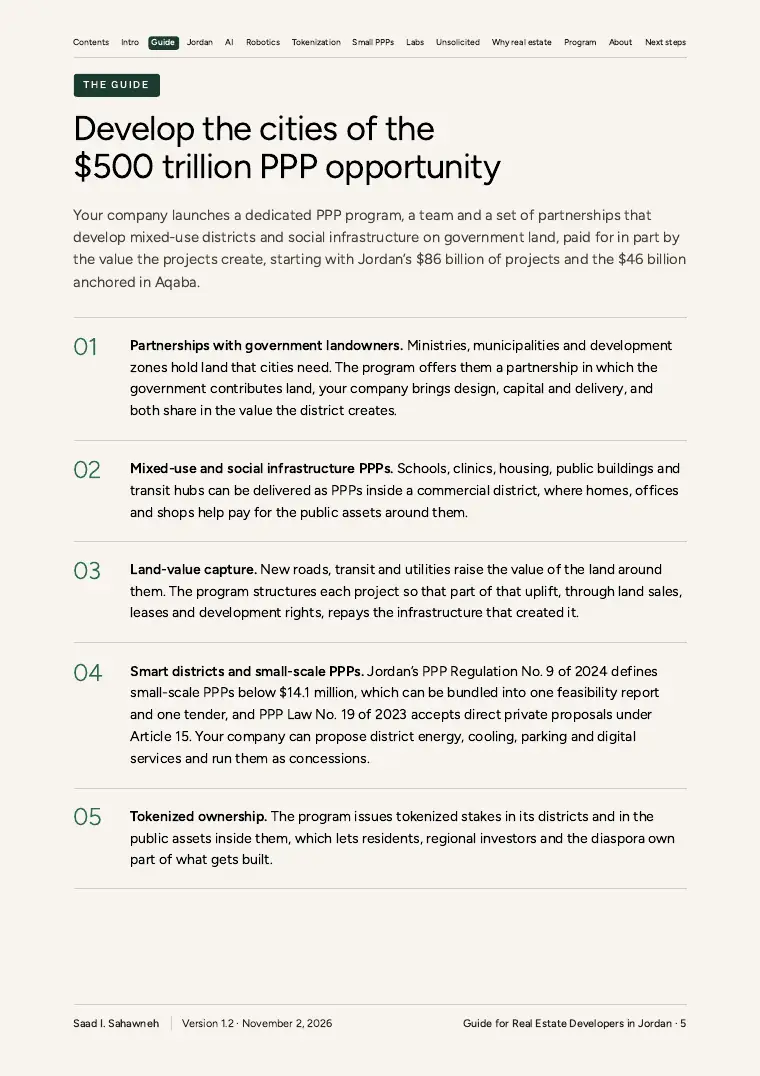
Develop the cities of the $500 trillion PPP opportunity
Your company launches a dedicated PPP program, a team and a set of partnerships that develop mixed-use districts and social infrastructure on government land, paid for in part by the value the projects create, starting with Jordan’s $86 billion of projects and the $46 billion anchored in Aqaba.
01
Partnerships with government landowners
Ministries, municipalities and development zones hold land that cities need. The program offers them a partnership in which the government contributes land, your company brings design, capital and delivery, and both share in the value the district creates.
02
Mixed-use and social infrastructure PPPs
Schools, clinics, housing, public buildings and transit hubs can be delivered as PPPs inside a commercial district, where homes, offices and shops help pay for the public assets around them.
03
Land-value capture
New roads, transit and utilities raise the value of the land around them. The program structures each project so that part of that uplift, through land sales, leases and development rights, repays the infrastructure that created it.
04
Smart districts and small-scale PPPs
Jordan’s PPP Regulation No. 9 of 2024 defines small-scale PPPs below $14.1 million, which can be bundled into one feasibility report and one tender, and PPP Law No. 19 of 2023 accepts direct private proposals under Article 15. Your company can propose district energy, cooling, parking and digital services and run them as concessions.
05
Tokenized ownership
The program issues tokenized stakes in its districts and in the public assets inside them, which lets residents, regional investors and the diaspora own part of what gets built.
Why real estate developers
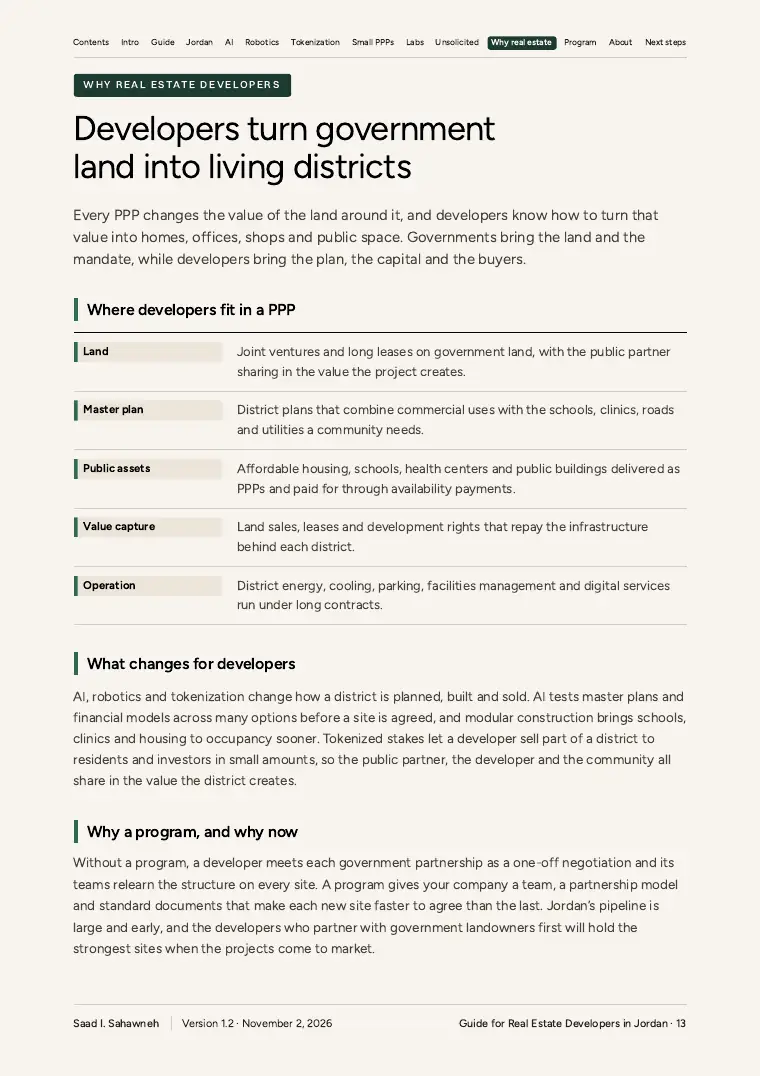
Developers turn government land into living districts
Every PPP changes the value of the land around it, and developers know how to turn that value into homes, offices, shops and public space. Governments bring the land and the mandate, while developers bring the plan, the capital and the buyers.
Where developers fit in a PPP
- Land
- Joint ventures and long leases on government land, with the public partner sharing in the value the project creates.
- Master plan
- District plans that combine commercial uses with the schools, clinics, roads and utilities a community needs.
- Public assets
- Affordable housing, schools, health centers and public buildings delivered as PPPs and paid for through availability payments.
- Value capture
- Land sales, leases and development rights that repay the infrastructure behind each district.
- Operation
- District energy, cooling, parking, facilities management and digital services run under long contracts.
What changes for developers
AI, robotics and tokenization change how a district is planned, built and sold. AI tests master plans and financial models across many options before a site is agreed, and modular construction brings schools, clinics and housing to occupancy sooner. Tokenized stakes let a developer sell part of a district to residents and investors in small amounts, so the public partner, the developer and the community all share in the value the district creates.
Why a program, and why now
Without a program, a developer meets each government partnership as a one-off negotiation and its teams relearn the structure on every site. A program gives your company a team, a partnership model and standard documents that make each new site faster to agree than the last. Jordan’s pipeline is large and early, and the developers who partner with government landowners first will hold the strongest sites when the projects come to market.

Futureproofing
Futureproof Real Estate Developers in Jordan for the infrastructure singularity
This free 17-page guide shows how, with small PPPs in parallel, PPP research labs, artificial intelligence, robotics, tokenization and six first steps.
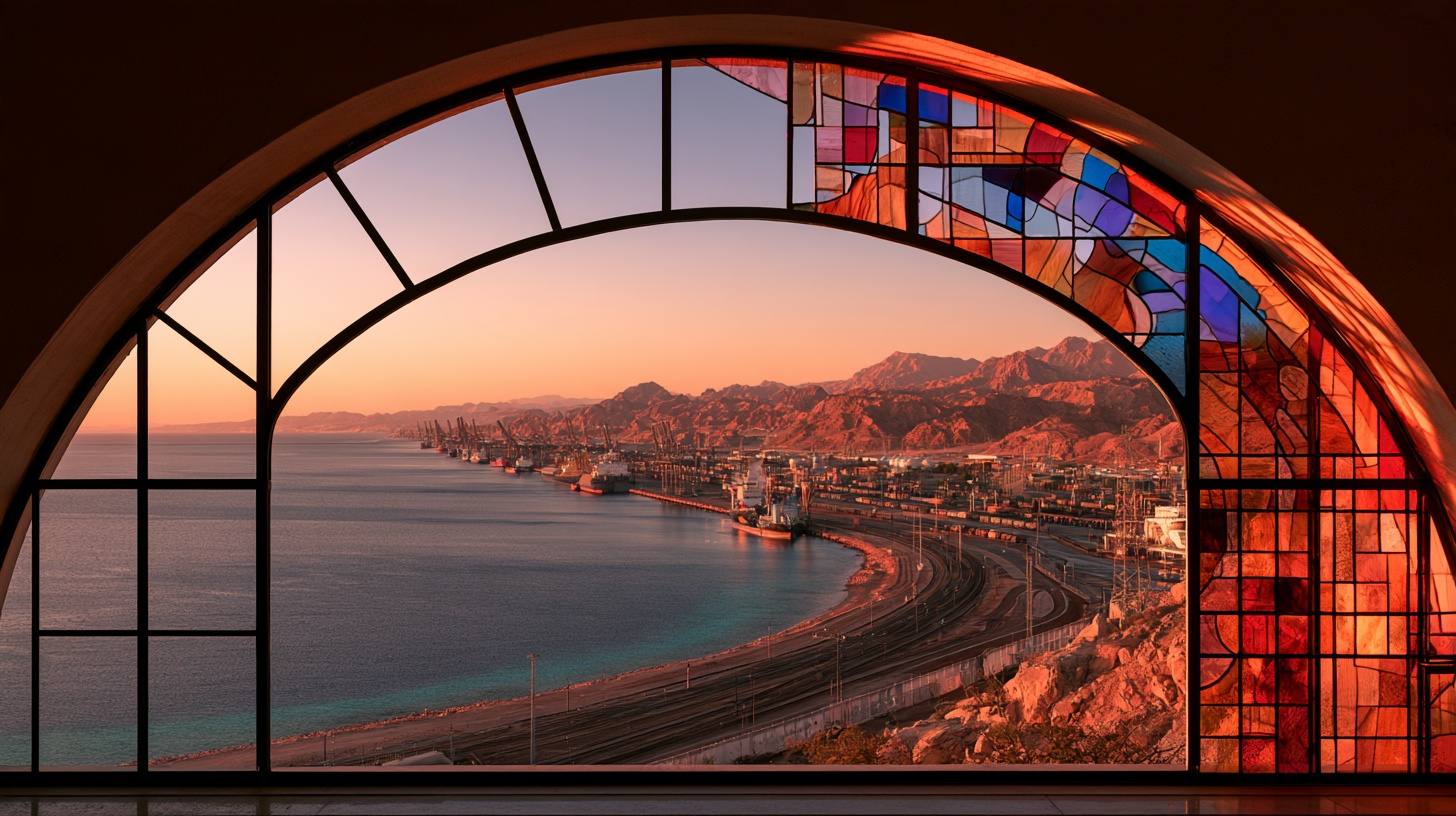
Jordan and Aqaba
An $86 billion pipeline to start with
Each of them changes the value of the land around it. A Jordanian developer that builds one district with government at home can carry the same partnership model to the next city across the region.
- $86B
- of PPP and infrastructure projects in development in Jordan
- $46B
- of them anchored in Aqaba

Artificial intelligence
AI lets a developer plan a district the way an operator will run it. Master plans, massing studies, cost plans and financial models can be tested across many options in days, and permits and approvals can move through digital workflows. Once the district is built, a digital twin runs its energy, water, parking and maintenance and shows the government partner how the public assets perform.

Robotics
Robotics and modular construction let a developer deliver social infrastructure at the speed and cost a PPP requires. Schools, clinics and housing built from factory modules reach occupancy sooner, and robots and drones keep the district’s buildings, utilities and public spaces in good order at a cost the developer can commit to for the life of the concession.

Tokenization
Tokenized title deeds already bring property onto token registers in the region. A developer can carry the same model into a PPP district, selling tokenized stakes in its homes, offices and public assets to residents and regional investors in small amounts, and paying holders from rents and availability payments as the money arrives.

Small PPPs and research labs
A new district is a natural home for a lab, because it can test smart buildings, district energy, water reuse and mobility on the developer’s own land. Small PPPs let a Jordanian developer prove these systems in one block before rolling them out across a district, and proven systems add value to the land around them.

Unsolicited proposals
Much of Jordan’s urban development will start as an idea for government land. A direct proposal lets a developer bring a district, a mini city or a piece of social infrastructure to government as its own project, funded by land value, and keep the right to match the best offer at tender.
The program
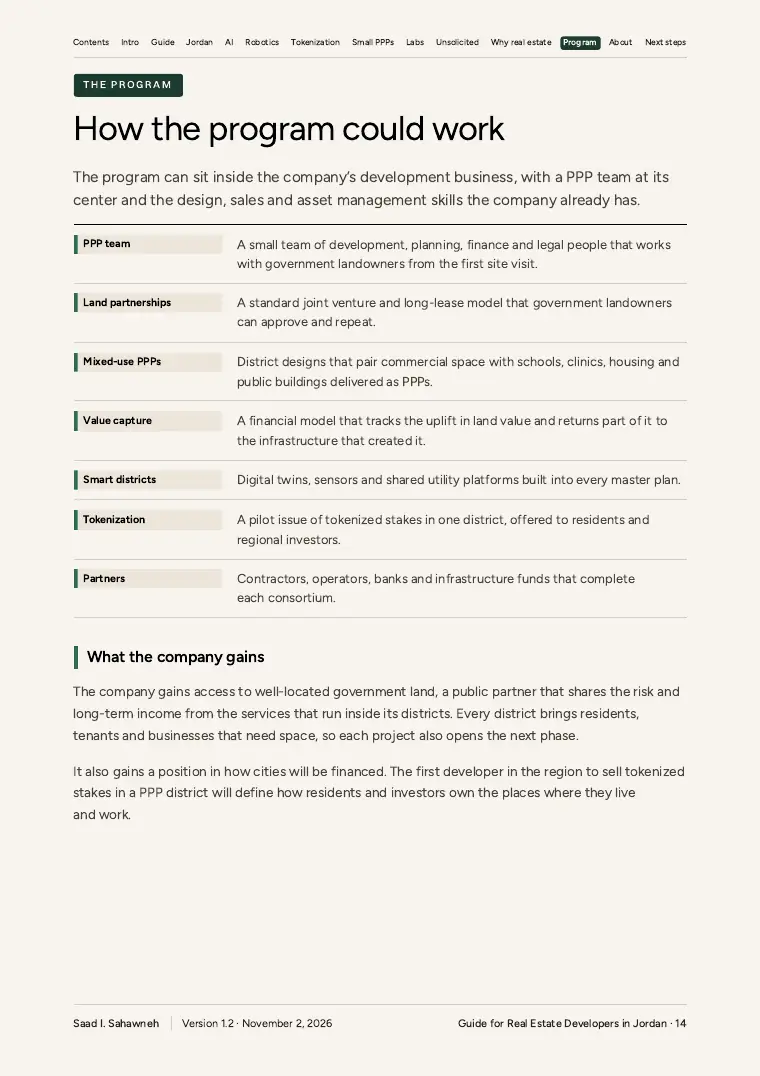
How the program could work
The program can sit inside the company’s development business, with a PPP team at its center and the design, sales and asset management skills the company already has.
- PPP team
- A small team of development, planning, finance and legal people that works with government landowners from the first site visit.
- Land partnerships
- A standard joint venture and long-lease model that government landowners can approve and repeat.
- Mixed-use PPPs
- District designs that pair commercial space with schools, clinics, housing and public buildings delivered as PPPs.
- Value capture
- A financial model that tracks the uplift in land value and returns part of it to the infrastructure that created it.
- Smart districts
- Digital twins, sensors and shared utility platforms built into every master plan.
- Tokenization
- A pilot issue of tokenized stakes in one district, offered to residents and regional investors.
- Partners
- Contractors, operators, banks and infrastructure funds that complete each consortium.
What the company gains
The company gains access to well-located government land, a public partner that shares the risk and long-term income from the services that run inside its districts. Every district brings residents, tenants and businesses that need space, so each project also opens the next phase.
It also gains a position in how cities will be financed. The first developer in the region to sell tokenized stakes in a PPP district will define how residents and investors own the places where they live and work.

Next steps
How a developer can start
Any real estate developer in Jordan can take this guide forward. The first steps use the land, teams and buyers the company already has.
01
Mandate
Board approval for a PPP program, with its target districts, the equity it can commit and its first-year goals.
02
Team
A named program lead, with development, planning, finance and legal people drawn from the company’s existing teams.
03
Pipeline
A map of government land, urban development projects and social infrastructure in Jordan’s $86 billion pipeline, and early meetings with the authorities that hold them.
04
Model
A land value and tokenized ownership model that funds districts and their social infrastructure.
05
Partners
Contractors, operators, banks and technology companies to complete each district consortium.
06
Pilot
A first district block, social infrastructure project or direct proposal, taken from idea to submission.
Jordan has the projects, the land and a law that accepts unsolicited proposals. A PPP program lets your company develop that land with government as its partner and gives it a head start in building the cities of the superintelligent infrastructure future.
The full document
Inside this guide
Seventeen pages and thirteen sections, from the case for a PPP program to the first steps, written for real estate developers in Jordan.
Download the guide (PDF)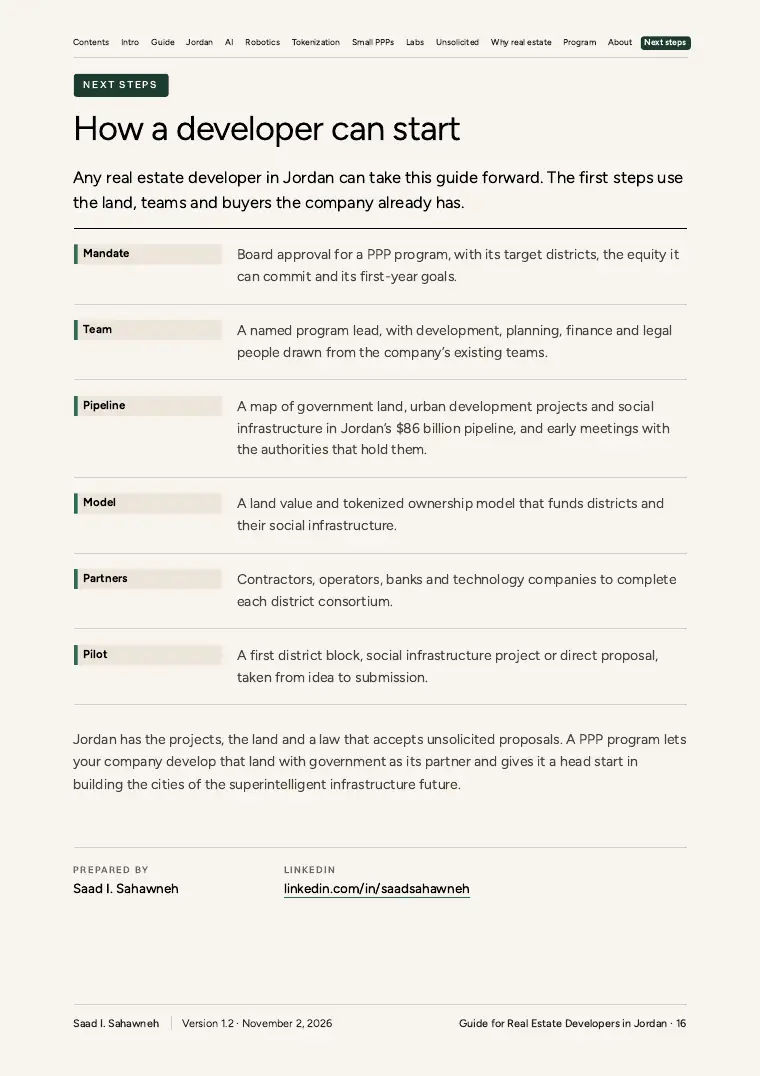
- 01IntroductionWhy a century of infrastructure needs rebuilding, and the $500 trillion it will take.p. 3
- 02The guideDevelop the cities of the $500 trillion PPP opportunityp. 5
- 03Jordan and AqabaAn $86 billion pipeline to start withp. 6
- 04Artificial intelligenceHow AI designs, structures and runs PPP projects, and what it means for developers.p. 7
- 05RoboticsHow robots build infrastructure and keep it running, and what that means for developers.p. 8
- 06TokenizationHow tokenization funds projects from their own revenue, and the role it opens for developers.p. 9
- 07Small PPPs in parallelWhy many small PPPs teach a country faster than a few large ones.p. 10
- 08PPP research labsA lab in each sector, running ten small PPP projects a year.p. 11
- 09Unsolicited proposalsHow Jordan’s PPP law accepts direct proposals from private companies.p. 12
- 10Why real estate developersDevelopers turn government land into living districtsp. 13
- 11The programThe program can sit inside the company’s development business, with a PPP team at its center and the design, sales and asset management skills the company already has.p. 14
- 12AboutAbout Jordan PPP and what it offers.p. 15
- 13Next stepsHow a developer can start: six first steps.p. 16
Questions
Questions about the guide for Real Estate Developers in Jordan
- What does the guide for Real Estate Developers in Jordan propose?
- Your company launches a PPP program to develop smart, mixed-use districts, affordable housing and social infrastructure on government land, funded by land value and tokenized ownership.
- Why should real estate developers in Jordan launch a PPP program?
- Developers turn government land into living districts. Every PPP changes the value of the land around it, and developers know how to turn that value into homes, offices, shops and public space. Governments bring the land and the mandate, while developers bring the plan, the capital and the buyers.
- Which PPP projects can real estate developers in Jordan take part in?
- Jordan has about $86 billion of PPP and infrastructure projects in development, $46 billion of them anchored in Aqaba. Each of them changes the value of the land around it. A Jordanian developer that builds one district with government at home can carry the same partnership model to the next city across the region.
- How can real estate developers in Jordan start a PPP program?
- Any real estate developer in Jordan can take this guide forward. The first steps use the land, teams and buyers the company already has. The guide sets out six first steps: mandate, team, pipeline, model, partners and pilot.
- What does a PPP program give real estate developers in Jordan?
- The company gains access to well-located government land, a public partner that shares the risk and long-term income from the services that run inside its districts. Every district brings residents, tenants and businesses that need space, so each project also opens the next phase.
- Is the guide for Real Estate Developers in Jordan free?
- Yes. It is free to read on this page and free to download as a 17-page PDF, with the case for a PPP program, Jordan’s pipeline, the role of AI, robotics and tokenization, the program and six first steps.
Guide 18 of 52
Browse all 52 guides