
Singularity · Small PPPs and research labs
Small PPPs and PPP research labs
The World Bank counted 315 private infrastructure projects reaching financial close across all low- and middle-income countries in 2024, only a few per country. Small projects run in parallel let a country test many legal structures, financing models and construction methods at once, and a research lab in each sector runs ten small PPP projects a year at up to $100,000 each and publishes every result.
- 780
- small PPPs a year in Jordan at $100,000 each, from 1% of 40 contracting authorities’ budgets
- 10
- small PPP projects a year in each sector’s research lab
- $10M
- spent preparing one $100 million PPP, enough for 100 pilots
In every guide
Two sections of every guide
Page 10
Small PPPs in parallel
Why many small PPPs teach a country faster than a few large ones.
Page 11
PPP research labs
A lab in each sector, running ten small PPP projects a year.
Each of the 52 guides writes this section for its own kind of organization; 52 of them are gathered below.
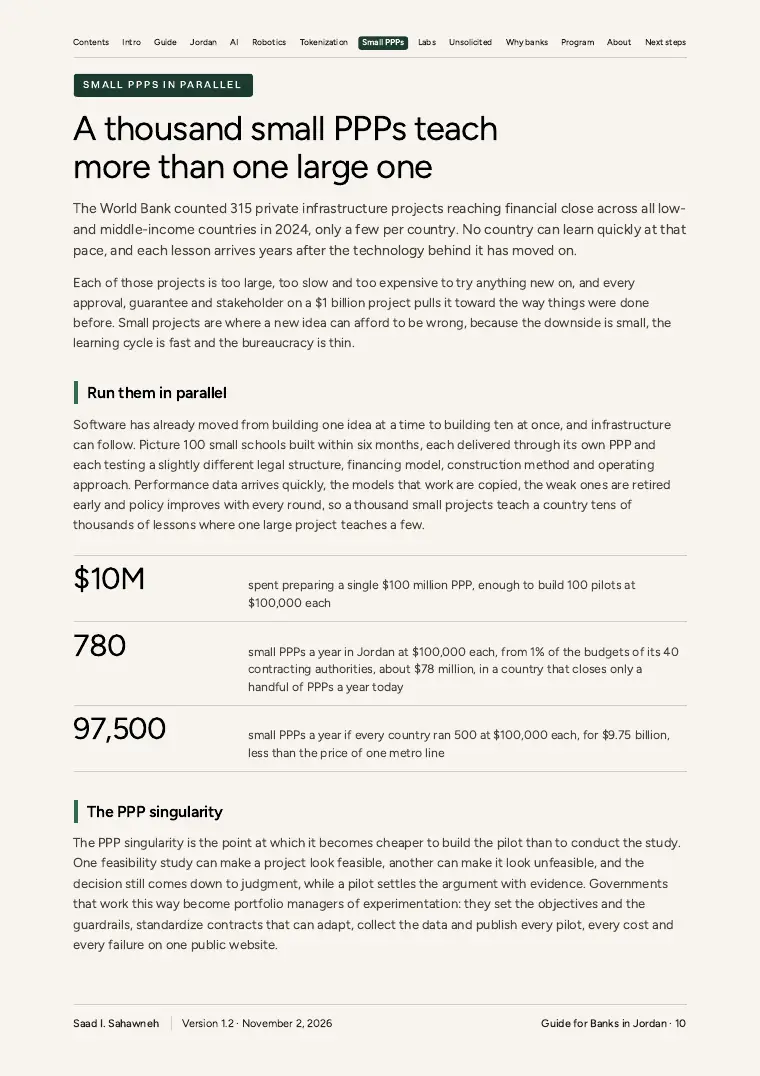
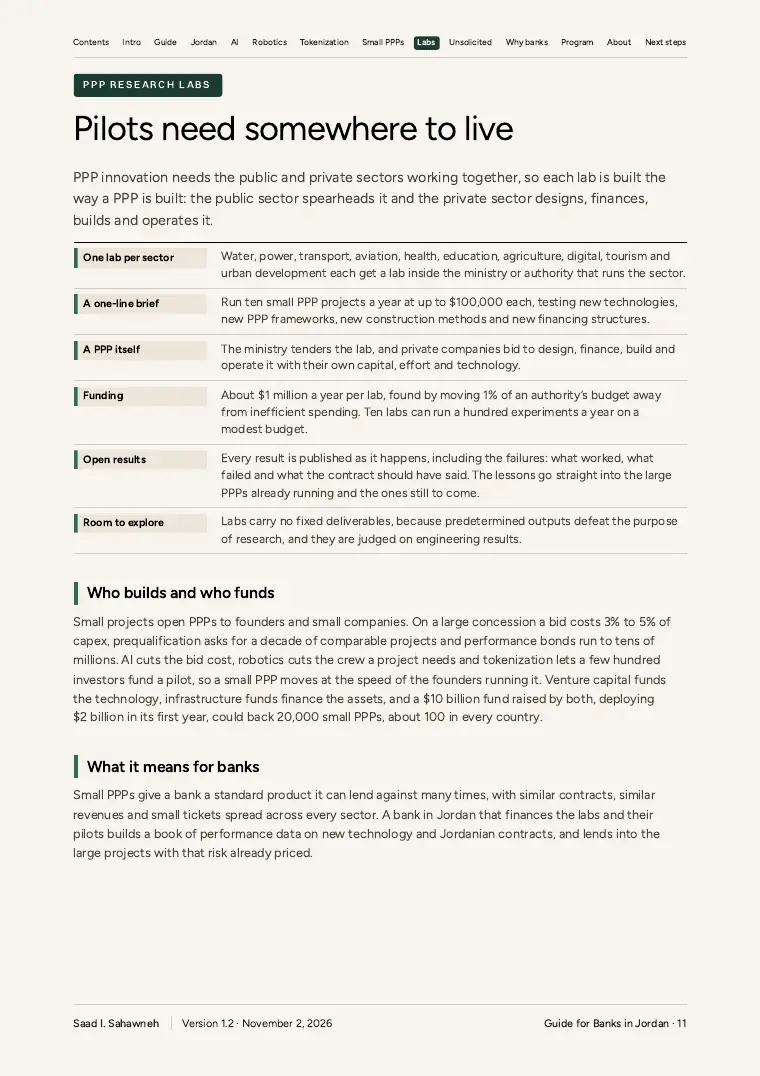
Pages 10 and 11 of the guide for banks
In the guides’ own words
“The lab sits inside the ministry, and the ministry writes its one-line brief.”
“Small PPPs give a bank a standard product it can lend against many times, with similar contracts, similar revenues and small tickets spread across every sector.”
“Small PPPs suit energy well, because a rooftop array, a battery at a substation or solar for a pumping station can be built quickly and measured from the first day.”
Why small PPPs
A traditional PPP can take more than 5 years to reach financial close
Each phase adds complexity, risk and cost. By the time a project breaks ground, prices have moved and political support may have faded, and construction and decades of operation still lie ahead.
Phase 1
Identification
6 months
Phase 2
Pre-feasibility
6 months
Phase 3
Full feasibility
12 months
Phase 4
Structuring and approvals
9 months
Phase 5
Procurement preparation
6 months
Phase 6
Tendering
12 months
Phase 7
Bid evaluation and negotiation
6 months
Phase 8
Award and financial close
6 months
Then design takes about 12 months, construction 36 months and operation 20 years. Infrastructure scales as a system, so a country that waits for each large project in turn falls further behind every year.
The PPP pyramid
PPP innovation must start with small projects
Every PPP sits somewhere on a scale of nine sizes, each ten times the last. Learning happens fastest at the base, where a country can run hundreds of pilots for the cost of studying one large project.
- Cosmic PPP$1 trillion
- Terra PPP$100 billion
- Giga PPP$10 billion
- Mega PPP$1 billion
- Metro PPP$100 million
- Urban PPP$10 million
- Mini PPP$1 million
- Micro PPP$100,000
- Nano PPP$10,000
From the 52 guides
What small PPPs and labs offer each kind of organization
Point at an organization to read what its guide says.Tap an organization to read what its guide says.
A national initiative gives small PPPs scale and visibility. Labs in many sectors can run pilots at the same time, publish their results in one place and open their work to young Jordanian engineers and founders, so the lessons from each round reach the large projects in the pipeline and the rest of the region can learn from them as well.
Read the guideFrom the center, the labs become one national portfolio. With 1% of each budget moved away from inefficient spending, Jordan’s 40 contracting authorities could fund about 780 small PPPs a year for about $78 million, and one shared brief, one model tender and one public record let every ministry learn from the pilots of the others.
Read the guide
The lab sits inside the ministry, and the ministry writes its one-line brief. A small team can tender the lab as a PPP, set its guardrails, collect the data from each pilot and carry what works into the large projects in the pipeline, and every published result, including the failures, teaches the other contracting authorities as well.
Read the guideA municipality is a natural home for small PPPs, because most city services already come in small pieces. A city lab can test sensor-led parking, smart street lighting or new waste contracts on a few streets, publish every result and carry what works across the whole city, funded by moving 1% of the budget away from inefficient spending.
Read the guideA state-owned company can run small PPPs on its own assets, such as leak reduction in one district, a battery at one substation or smart meters on one street, and measure each result from the first day. Its lab can test many of these at once, publish every result, including the failures, and carry what works across the whole network.
Read the guideSmall PPPs give a regulator a low-risk place to learn. Bundled small-scale projects can test tokenized notes, small issues and new forms of disclosure on real assets inside a sandbox, with caps that limit what any investor can lose, and each published result shows what the permanent rules should say.
Read the guide
03Capital
Small PPPs give a bank a standard product it can lend against many times, with similar contracts, similar revenues and small tickets spread across every sector. A bank in Jordan that finances the labs and their pilots builds a book of performance data on new technology and Jordanian contracts, and lends into the large projects with that risk already priced.
Read the guideSmall PPPs give development finance a way to test new technology, contracts and financing structures on real assets at low cost. A development finance institution can fund the labs and their pilots through grants or concessional tranches, require every result to be published and carry what works into the large loans and guarantees it plans in Jordan.
Read the guideSmall PPPs are where the technology a fund’s large assets will run on gets proven first. A fund that backs the labs, or joins venture capital firms in a fund for small PPPs, sees the results early and enters the large projects with technology risk already priced.
Read the guideSmall PPPs can serve as the research budget of a long-term portfolio. A modest allocation to labs and pilots shows a fund which technologies, contracts and operating models work before it commits patient capital to the large projects that will use them for decades.
Read the guideEvery pilot produces loss and performance data on a new technology, construction method or contract. An insurer that covers the labs and their pilots builds the data to price those risks before they reach the large projects, and writes cover for new kinds of infrastructure ahead of the market.
Read the guideSmall PPPs come in tickets a family office can hold directly. A Jordanian family can back a lab, take stakes in a portfolio of pilots across several sectors and follow on into the technologies and project companies that prove themselves, with returns paid from each asset’s own revenue.
Read the guideSmall PPPs turn infrastructure into the kind of market venture capital already knows, with many small bets, fast iteration and follow-on in the ones that work. A firm that backs startups running pilots in the labs sees which technologies earn revenue on real assets, and can raise a shared fund with infrastructure investors to scale them.
Read the guideSmall PPPs run on the model an accelerator already knows: many small bets, fast cycles and follow-on in the ones that work. A research lab can host a cohort of Jordanian founders testing their products on real public assets, and every pilot gives a founder a first customer at home, a reference and the data for the next round.
Read the guide
Small PPPs let a developer test new structures at low risk and learn at the pace of many projects. A Jordanian developer can run a portfolio of lab pilots in parallel, each with a different contract, financing model or technology partner, and carry the structures that work into its large bids with evidence from live assets.
Read the guideA zone suits a PPP research lab, because it holds land, networks and tenants willing to try new services in one place. Each zone can tender its own lab, pilot new utilities, logistics robots and smart-zone tools on its own plots and offer what works to every tenant, while the published failures teach the other zones as well.
Read the guideSmall PPPs are the lowest-risk way for a contractor to become a developer. A Jordanian contractor can design, finance, build and operate a pilot with its own crews and equipment, test modular methods and robotics on a live asset and arrive at the large concessions with operating data its competitors only hold on paper.
Read the guideA new district is a natural home for a lab, because it can test smart buildings, district energy, water reuse and mobility on the developer’s own land. Small PPPs let a Jordanian developer prove these systems in one block before rolling them out across a district, and proven systems add value to the land around them.
Read the guideEvery lab needs designers, cost planners, technical advisors and people who can turn a pilot’s results into a contract the next project can reuse. An engineering firm that designs and monitors small PPPs builds the evidence, the templates and the benchmarks that Jordan’s ministries and lenders will ask for on the large projects.
Read the guide
05Advisors and professional bodies
Each lab is a working test of contract design. Every pilot shows what the contract should have said, and a firm that drafts and reviews small PPPs builds the standard, adaptable templates Jordan needs to run hundreds of projects a year, along with the know-how for tokenized and technology-heavy concessions.
Read the guideEvery lab pilot needs a budget, a funding structure and a record of what each result cost. A financial advisory firm that models small PPPs builds standard, auditable models that Jordan can reuse across hundreds of projects a year, and it can test new financing structures, from tokenized notes to bundled tenders, before they reach a large concession.
Read the guideSmall PPPs are where most member firms can enter the market, because the projects are sized to the firms. A professional body or chamber can run a lab of small pilots with its members, test new methods, AI tools and robotics on live projects, publish every result, including the failures, and carry what works into its training and templates.
Read the guide
Small PPPs let an operator test new ways to run assets at low risk, from sensors and digital twins to robotic maintenance and new service contracts. Every pilot leaves behind operating data that sharpens the operator’s pricing, and an operator that runs labs sees the next generation of assets before they reach tender.
Read the guideSmall PPPs let a facility management company test new ways to run buildings at low risk, from sensors and cleaning robots to energy retrofits and outcome-based service contracts. Every pilot leaves behind data on cost, availability and response times that sharpens the company’s pricing, and the lab results become the service levels Jordan writes into its larger hospital, campus and station PPPs.
Read the guideEvery lab needs its pilots connected, monitored and reported in public. A telecom operator can connect small PPPs across many sectors at once, give each pilot its sensors, data and compute as one service and carry the results into the large projects, where the same network becomes part of the specification.
Read the guideSmall PPPs let a logistics company test new ways to move cargo at low risk, from an automated gate at a dry port to a digital corridor at a border crossing. Every pilot leaves behind throughput data that sharpens the company’s pricing, and a company that runs pilots sees the next generation of terminals and corridors before they reach tender.
Read the guideSmall PPPs let a hospital group test new models of care at low risk, from AI triage and remote monitoring to robotic pharmacies and modular clinics. A health lab inside the group can run these pilots in a handful of clinics, publish what works and give the group the evidence it needs before the same model reaches a large hospital tender.
Read the guide
Every lab is a paying first customer for new technology on a real public asset. A technology company can place its AI, robotics, sensors or tokenization platform into small PPPs across many sectors at once, prove it quickly and carry the results into the large projects as a reference that buyers can visit.
Read the guideSmall PPPs work only when preparing them costs little, and AI is what brings that cost down. An AI company can prepare the studies, contracts and tenders for a whole round of lab pilots at once, train its operating models on the data each pilot publishes and prove its accuracy in public, which builds the track record that large concessions ask for.
Read the guideSmall PPPs suit robotics well, because a robot-built pumping station or a round of drone inspections can be delivered quickly and measured from the first day. A robotics company can run lab pilots on many sites at once, test new machines on live public assets and carry the results into large concessions as evidence that its fleet performs.
Read the guideEvery small PPP is a chance to tokenize a real asset at low risk. A blockchain company can fund lab pilots from a few hundred investors, pay them from each asset’s own revenue and publish every result on a ledger the public can read, which turns the labs into Jordan’s first live market for tokenized infrastructure.
Read the guideA university is a natural partner for a lab. Its researchers and students can design, build and measure small PPPs on campus and in the community, publish every result and train the engineers, lawyers and financiers who will run hundreds of PPPs a year.
Read the guideA school is a natural home for small PPPs. Its roofs, water systems and transport are ready-made pilots that a partner can improve and measure within a school year, and every result can be shared with other schools and taught in class.
Read the guide
Small PPPs suit energy well, because a rooftop array, a battery at a substation or solar for a pumping station can be built quickly and measured from the first day. An energy developer can run lab pilots across many sites at once, test new storage, dispatch and hydrogen technology on live assets and carry the best results into its large bids.
Read the guideSmall PPPs suit fuel networks well, because a gas connection to a public building, a biogas unit at a landfill or a hydrogen pilot at an industrial site can be built quickly and measured from the first day. An oil and gas company can run lab pilots across many sites at once, test new leak detection, inspection and fuel technology on live assets and carry the best results into its large bids.
Read the guideSmall PPPs suit water well, because leak reduction in one district, greywater reuse in a public building or solar for a pumping station can be built quickly and measured in liters from the first day. A water company can run lab pilots across many sites at once, test new sensors, robots and treatment methods on live assets and carry the best results into its large bids.
Read the guideSmall PPPs suit transport well, because a feeder bus route, a smart parking site or an electric bus depot can be set up quickly and measured from the first trip. A transport company can run lab pilots on many routes and sites at once, test new vehicles, ticketing and dispatch on live services and carry the best results into its large bids.
Read the guideSmall PPPs suit agriculture well, because a hydroponic unit, a solar-powered well pump or a cold store at a local market can be built in one season and measured from the first harvest. An agriculture company can run lab pilots across many farms at once, test new crops, irrigation and robotics on live sites and carry the best results into its large bids.
Read the guideSmall PPPs let a mining company prove new methods on assets it already understands. Water reuse, solar with storage or a rail siding near a mine can be built quickly and measured from the first day, and lab pilots can test autonomous haulage, ore sorting and low-water processing before the company scales them across its sites.
Read the guideSmall PPPs suit factory-made infrastructure well, because a modular clinic, classroom or water unit can be built quickly and measured from the first day. A manufacturer can supply lab pilots across many sites at once, test new materials and production methods on live assets and carry the best designs into its product lines for large projects.
Read the guideSmall PPPs let a life sciences company test new models of supply and testing at low risk, from AI stock forecasting and smart medicine cabinets in a few clinics to point-of-care testing and automated laboratories. A health lab inside the ministry can run these pilots across several sites, publish what works and give the company the evidence it needs before the same model reaches a national tender.
Read the guideSmall PPPs let a tourism company test new visitor experiences at low risk, from an eco-lodge or a trail network to digital ticketing and visitor-flow systems at a heritage site. A tourism lab can run these pilots at several sites at once, publish what works and give the company the evidence to scale the best ideas into larger concessions.
Read the guideSmall PPPs suit education well, because a classroom block, a training workshop or a digital learning pilot can be set up within a school year and measured from the first term. An education company can run lab pilots across many schools and centers at once, test new teaching tools and building methods and carry the best results into its larger bids.
Read the guideSmall PPPs suit the circular economy well, because a sorting line for one municipality, a composting site at a market or a crusher on a demolition site can be built quickly and measured in tons from the first day. A circular economy company can run lab pilots across many sites at once, test new sorting, recovery and tracking technology on live waste streams and carry the best results into its large bids.
Read the guideSmall PPPs suit the green economy well, because a retrofit, a charging hub or a solar-powered pump can be built quickly and its savings measured from the first day. A green economy company can run lab pilots across many sites at once, test new materials, controls and financing structures on live assets and carry the best results into its large bids.
Read the guideSmall PPPs suit creative work well, because a pop-up exhibit, a studio fit-out or a digital guide for a heritage site can open quickly and be measured from the first visitor. A creative company can run lab pilots at many venues and sites at once, test new immersive formats and visualization tools and carry the best results into larger concessions.
Read the guideSmall PPPs let a sports and entertainment company test new venue models at low risk, from a community pitch run on digital booking to a pop-up arena or a park concession with events. A sports lab inside the ministry or a municipality can run these pilots at several sites at once, publish what works and give the company the evidence to scale the best ideas into larger concessions.
Read the guide
Humanitarian services already come in small pieces: a water point, a solar roof, a clinic, a classroom. A humanitarian lab can test metered water, solar power or new waste contracts in a few locations, publish every result and carry what works across camps and host towns, funded by moving part of a grant budget from short-term spending into long-term partnerships.
Read the guideSmall PPPs give donors a way to test new technology, contracts and finance on real assets at low cost. A donor can fund the labs and their pilots, require every result to be published and carry what works into larger programs, so grant money buys evidence as well as services.
Read the guideCharities already work in small pieces: a family, a street, a school. A community lab can test solar for low-income homes or water-saving retrofits on a few streets, publish every result and carry what works across the country, funded by placing part of each year’s giving behind pilots that last.
Read the guideHost towns need many small fixes fast: a reservoir here, a drain there, backup power for a clinic. A resilience lab can test flood sensors, drone fire monitoring or solar backup on a few sites, publish every result and carry what works across every host town, funded by moving 1% of the budget away from inefficient spending.
Read the guideSmall PPPs suit social enterprises because their services already come in small, repeatable units. A lab can test a water kiosk, a solar clinic or a recycling service in a few towns, publish every result and carry what works across the country, and each pilot gives impact investors the evidence they need.
Read the guide
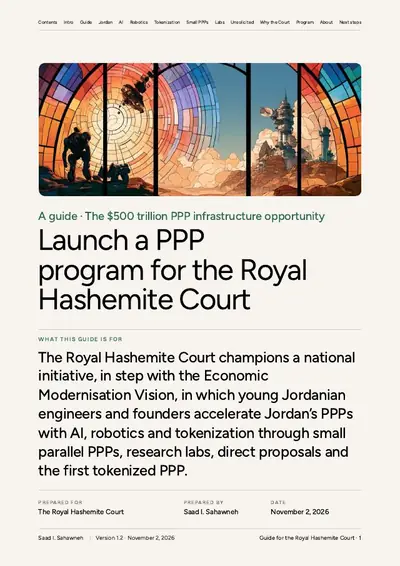
01 · National leadership
Royal Hashemite Court
Small PPPs and research labs
A national initiative gives small PPPs scale and visibility. Labs in many sectors can run pilots at the same time, publish their results in one place and open their work to young Jordanian engineers and founders, so the lessons from each round reach the large projects in the pipeline and the rest of the region can learn from them as well.
More on the singularity
 The infrastructure singularityThe $500 trillion rebuild
 Futureproof your organizationWhat changes, and where to start
 Artificial intelligenceDesigns, structures and runs the assets
 RoboticsBuilds the assets and keeps them running
 TokenizationFinances the assets and opens ownership
 Unsolicited proposalsTake your own PPP idea to government